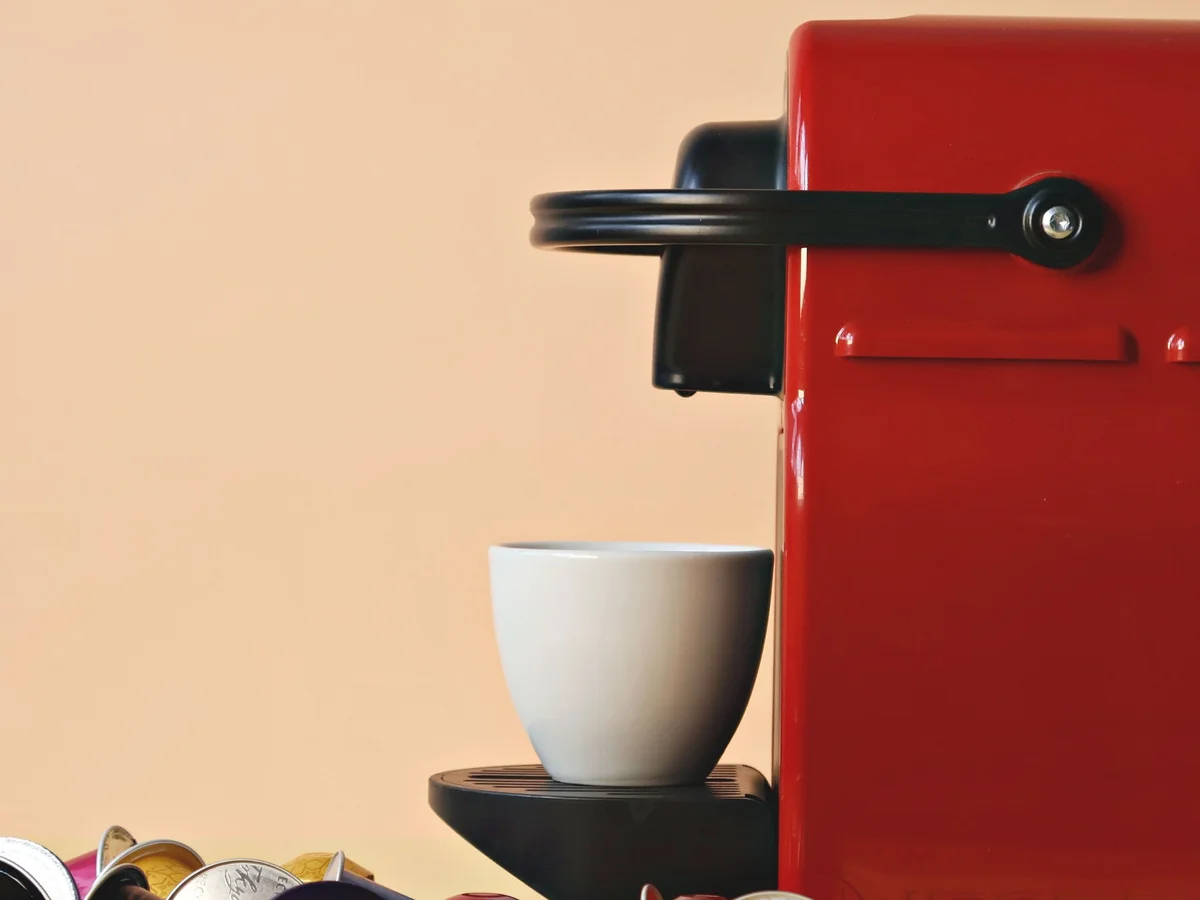
Coffee maker
Pod or capsule machine
A machine that brews a single pre-portioned pod or capsule of coffee, prioritising speed and consistency over control.
In short
A capsule machine takes the decisions out of espresso by fixing them in advance. The dose, the grind and the freshness are settled in a factory and sealed; the machine supplies hot water under pressure. What is left to the person at the counter is which capsule to buy and how much water to run through it.
That makes a capsule unusually easy to study, because the machine is the same every time. One group did exactly that, and its measurements are the backbone of this page.
What was in 43 capsules
Sourced
A Swiss group bought 43 different capsules of one shape, all for the same machine, opened some and brewed the rest to a fixed 40 gram drink. These are the lowest and highest values in their table.
| Variable | Typical range | What moving it does |
|---|---|---|
| Coffee in the capsule | about 5.0 to 6.2 g | A good deal less than the dose in a café's double espresso basket. |
| Median particle size | 255 to 549 micrometres | More than a twofold spread between the finest and coarsest. |
| Share of fines, under 100 micrometres | 5.3 to 15.8 per cent | |
| Oxygen inside the capsule | 0 to 20 per cent | Thirty-nine of the 43 were at 1 per cent or below; three were between 2 and 6 per cent, and one was at 20, about the level in air. |
| Time to deliver 40 g | 11 to 41 seconds | |
| Dissolved solids in the drink | 2.15 to 3.64 per cent | |
| Extraction | 15.7 to 26.0 per cent |
One capsule format on one machine at one drink size, from capsules on sale when the study was done. The ranges describe that sample. Other systems use different doses, pressures and drink sizes, and nothing here transfers to them.
What decided how strong the drink was
Sourced
The authors conclude that the most efficient ways to raise the dissolved solids in the drink are to put more coffee in the capsule or to grind it finer, with the limit that too fine a grind restricts flow excessively. Neither is in the buyer's hands.
Their new finding was about fines. For capsules of similar median particle size, those with a larger share of very small particles took longer to extract, and they propose that share as a second number that has to be known to understand how a capsule will behave. Longer extraction went with stronger drinks; the weight of coffee in the capsule showed no relation to the percentage extracted.
Three certified tasters agreed a score for each coffee for flavour, acidity, body and balance, on a scale from 5 to 10 on which 6 stood for average. Most scores sat close to 6 and did not follow the technical measurements. The authors read this as showing that most of the capsules were made to a similar standard, and they note two capsules with more oxygen inside that scored lower, and two single-origin coffees that scored higher.
The path of the water
Widely documented
How a pressure-capsule system works in outline. Systems differ in detail and makers describe their own.
Pierce
Closing the machine punctures the capsule so that water can enter. The coffee has been sealed since it was filled.
Fill and build pressure
A pump drives hot water into the capsule. The packed coffee and the capsule's outlet resist the flow, and pressure rises.
Release
The outlet opens or is torn against a plate and coffee flows into the cup, passing through the bed of grounds on the way.
Stop
The machine stops at a set volume, or when the button is released. This is the one brewing variable left to the user.
A model of a pressure-capsule brew, from general description. It shows where the fixed and the adjustable parts of the recipe sit, and carries no measurements.
Sealed, but not all sealed alike
Sourced
A capsule holds ground coffee, which loses its gas and aroma far faster than whole beans once exposed. The seal is the whole point. In the 43-capsule study nearly all had 1 per cent oxygen or less inside. One had about as much as ordinary air, which means that capsule's coffee was effectively unprotected.
A separate study from the same institute followed chemical markers of freshness in four commercial capsule systems during storage. Those made with a layer of aluminium preserved the markers better than those without. That was a chemical measurement, and the authors said research was continuing into whether it shows in the cup.
Recyclable, compostable: what one assessment modelled
Sourced
Claims about capsule packaging are claims, and they depend on what happens after the capsule leaves the kitchen. One life cycle assessment, of pods used on a university campus in the United States, shows how much turns on that. It compared the packaging of a plastic pod with that of a compostable one, each counted as the packaging for one 8-ounce serving, and nothing else: the coffee inside, the machine and its electricity were outside what it modelled.
On energy used to make and dispose of the packaging, the plastic pod sent to landfill came out lowest. Across ten other environmental measures the picture changed, and the worst case in eight of the ten was a compostable pod that ended up in landfill instead of a composting facility. In a trial at the campus's industrial composting site the compostable pods broke down completely within 46 days.
These are modelled results for one place. The same paper reports an earlier assessment of drip, French press and pod coffee, which CoffeeHQ has not opened, as finding single-serve pods to have a lower impact than drip filter coffee, and as warning that the different amounts of coffee each method uses can shift the burden from one stage to another. The authors themselves note that studies of pods differ so much in boundaries, methods and scale that their results cannot be laid side by side. So the studies do not agree on a verdict, and this page gives none. The certification the authors describe as relevant in the United States is to standards for industrial composting, which is not the same thing as breaking down in a garden heap.
The few things you can change
CoffeeHQ explanation
- Thin and bitter when run into a large mug
Usually because: A capsule holds five or six grams of coffee. Running a long drink through it passes a lot of water through very little coffee.
Change first: Run the short programme and top up with hot water afterwards.
- Weak, whatever the setting
Usually because: The dose is fixed, so strength can only come from using less water.
Change first: Shorten the drink, or use two capsules for one cup.
- Tastes flat or stale from a new box
Usually because: It may be the capsule. The study above found one capsule on sale with as much oxygen inside as ordinary air, and two with more oxygen that scored lower when tasted.
Change first: Try a different brand before blaming the machine.
Looking after one
Widely documented
There is little to do: empty the used-capsule drawer, rinse the drip tray, and run water through the brewing head now and then. Scale builds up in any machine that heats water. How often to descale, with what, and whether the machine tells you, are the maker's instructions for that model; follow those and not a general rule.
Where the evidence on capsules stops
CoffeeHQ explanation
It names no brand and recommends none. It does not say capsule coffee is better or worse than other coffee: the one tasting read found the scores bunched together and unrelated to what was measured. It gives no pressure for capsule machines, since none was read from a measurement. It does not say whether capsules are greener or less green than other ways of making coffee; the assessment described covers packaging alone. It says nothing about aluminium or plastic and health. And every figure in the first table belongs to one capsule format.
What to do next
- Pod machine or bean-to-cup? — The other one-button way to make espresso-style coffee, and what each fixes for you.
- Pressure and flow in espresso — What resistance and flow do in an espresso bed, which is what a capsule is in miniature.
- Grind size — Why a grind is a spread of sizes, and why the share of fines matters.
- Why coffee goes stale — The packaging study in full, including what the aluminium layer did.
- Sustainability claims — How to tell a measured result from a modelled one and from a seller's statement.
- Become a barista — A structured programme from dose and grind through milk, drinks and maintenance.
How it works
A sealed, pre-ground and pre-dosed pod or capsule is pierced and brewed through by the machine using a fixed pressure and volume programme specific to that pod system.
Who it suits
- users who want a fast, no-mess, no-grinding single cup
- low-volume households or single users
Who it may not suit
- users who want to choose their own beans freely
- users trying to minimise ongoing consumable cost or packaging waste
- Capacity
- 1 cup
- Brew time
- 1 min
- Skill level
- beginner
- Noise
- quiet
- Space
- compact
- Cleaning burden
- low
- Convenience
- high
- Manual control
- low
Advantages
- very fast and consistent
- minimal mess or skill required
- compact for many models
Disadvantages
- ongoing per-cup cost of pods is typically higher than loose beans
- limited or no control over bean choice, dose or grind
- packaging waste is a common criticism
Taste variables you can control
Derived from CoffeeHQ's own Change the Taste guidance for this machine, not a marketing feature list.
- Machine volume setting
- Water amount
- Dose
- Cleaning, prep or maintenance
Change the taste
Tastes harsh or dry
(Pod or capsule machine)A long or large drink from a single capsule tastes bitter and thin at once — usually too much water pushed through one dose.
Try the first step below on its own, taste, then move to the next one only if needed.
| Change | Try | Why | Watch for |
|---|---|---|---|
| FirstMachine volume setting | Decrease: choose the shorter extraction setting, then top up separately | Avoids over-extending one capsule's dose, which is what causes bitterness alongside thinness. | — |
| Water amount | Increase: add hot water or milk after brewing, rather than during | Dilutes to the size you want without over-extending the capsule itself. | — |
| Dose | Increase: use two capsules for a larger drink where supported | Keeps strength proportionate to the final size. | — |
| Cleaning, prep or maintenance | Check / reset: descale and clean the machine per the manufacturer's schedule | Scale and residue affect flow and flavour independent of capsule choice. | — |
When to reset: This system doesn't allow fine-grained grind or dose control the way a grinder-based method does — the realistic levers are capsule choice/strength setting, using an extra capsule for a larger drink, drink size, and cleaning.
Cleaning & maintenance
Empty the used-pod container and wipe the brewing head regularly.
Follow the maker's instructions. How often depends on water hardness and use, and some makers advise against owners descaling certain machines.
Minimal — mostly limited to descaling and seal replacement over time.
Consumables: compatible pods/capsules, descaling solution
Common faults
- weak or inconsistent extraction if using non-official pods not matched to the machine
- blocked piercing needle if not cleaned
Cost
Purchase cost band: budgetMachine purchase price is often low or subsidised, with the ongoing cost concentrated in pods instead.
Per-cup pod cost is typically higher than an equivalent dose of loose beans; this is the main long-term running-cost trade-off of this category.
What these machines can actually do
This is a category, not a product, and machines within it genuinely differ. Where a capability varies, the answer is not on this page — it is on your machine, and each entry says how to find it.
Check these on your own machine
Pannarello or assisted wand
A plastic collar around the metal wand, usually with a small hole in the side. Pulling it off — if the manual allows — exposes the bare tip underneath.
Where a wand exists at all it is usually assisted, and steam capacity is limited.
Automatic milk system
A milk carafe or a tube that goes into a milk container, plus a milk button on the panel.
Workflow and fittings
- Takes a standard single-wall basketNever
This is the upgrade path. A machine that accepts a single-wall basket can make real espresso once there is a grinder to match; one that cannot is capped wherever it is.
The capsule is the basket. There is no grind, dose or distribution to control, which is the whole proposition.
Water and pressure release
- Three-way solenoid valveNever
It decides two things people worry about for no reason. It is what leaves a firm, dry puck that knocks out cleanly — and it is why a machine without one leaves a wet, soupy puck that is not a fault. It is also what makes backflushing possible: without a three-way valve there is nowhere for the water to go, and the procedure does nothing.
What it does not mean: A wet puck is not evidence of a bad extraction. On a machine with no three-way valve it is the expected result, and no amount of grind or dose adjustment will change it.
- Removable water tankAlways
You choose the water, which is the cheapest way to control scale and taste. It also needs emptying and cleaning: a tank left standing grows things, and a machine left full over a holiday is worse than one left empty.
Heat and temperature
- Thermoblock or thermocoilAlways
Very fast warm-up, small and cheap. Temperature is less stable across a shot than a boiler's, and steam capacity is usually limited, which is what makes milk texturing harder on these machines.
Brewing and pressure
- Pump-driven brewingAlways
A pump holds pressure steady without effort, which is what makes shot-to-shot consistency achievable. It also means the pressure is a property of the machine rather than of your arm.
- Volumetric dosingAlways
Repeatable without attention, which matters in a café. At home it measures volume rather than the mass in the cup, so it drifts as the coffee ages and the puck resists differently.
What it does not mean: A programmed volume is not the same as a weighed yield. If you are dialling in by ratio, weigh the cup.
Milk
- Pannarello or assisted wandVaries — check yours
It makes foam almost regardless of technique, which is exactly why it cannot make microfoam: the air is introduced by the sleeve rather than by you, and the foam is airy and coarse. Many machines let you remove the sleeve, which converts it into a conventional wand.
- Automatic milk systemVaries — check yours
Removes the skill entirely and adds a non-optional daily cleaning routine, because milk sits in warm tubing between drinks.
Compare
Related guides
Not sure if this is right for you? Try the coffee-maker selector.