Foundational
Storing coffee: beans, ground, instant and frozen
How to keep each kind of coffee, what a freezer trial and the packaging studies measured, and where the usual advice is custom.
In short
Coffee is spoiled by four things: oxygen, moisture, warmth and time. Which matters most depends on what form the coffee is in. For roasted beans it is oxygen and the escape of aroma; for instant coffee it is moisture; for a jar of cold brew it is microbes.
This page goes through the forms in turn. Where something was measured it says what; where the advice is custom it says that. It gives no number of days for any of them.
Whole roasted beans
Sourced
Roasted beans lose gas for weeks and their aroma drifts as some compounds evaporate and others react. Both have been measured, and the details are on the page about why coffee goes stale. The finding that bears on storage is about the bag: in one study, whole beans kept for over a year in bags with an aluminium layer held their chemical markers of freshness nearly steady, while beans in plain paper and in a plain plastic film changed measurably within two weeks.
That supports keeping beans in the bag they came in if it is a foil-lined one with a valve, squeezed and resealed, or in a container that seals. Dark, cool and dry are the customary conditions and are sensible; no study of light or of cupboard temperature was read.
The freezer: one trial, read in full
Sourced
One study tested freezing directly. A single lot of Zambian coffee was roasted to a light and a dark degree, rested for 15 hours in open paper bags, then put in amber glass containers and kept for nine weeks either in a chest freezer or in a dark cabinet at room temperature, which the paper gives as 25 degrees Celsius. The paper gives the freezer as minus 20 degrees in its design and as set at minus 18 where it describes the storage. A control was roasted the day before the test.
Forty-eight coffee drinkers were given the freshly ground coffees to smell, without knowing which was which, and asked to arrange them by similarity. For the dark roast they placed the frozen coffee closer to the newly roasted control than the coffee kept in the cabinet. For the light roast the storage conditions made a smaller difference. The instrument measurements of the aroma compounds showed the same pattern, and on that basis the authors recommend the freezer over room temperature, most of all for dark roasts.
The limits matter, and the authors state them. It was one coffee, nine weeks, and judged by smell alone: nothing was brewed or tasted, and they say it would be important to test whether the same holds when the coffee is tasted. The frozen containers were taken out a day ahead and left to reach room temperature overnight before the coffee was ground; whether grinding straight from frozen would have done as well was not tested.
If you freeze, the usual precautions
CoffeeHQ explanation
These are the precautions commonly given. They follow from how condensation forms on anything cold, and were not tested in the study above.
- Freeze in portions. Divide the beans into amounts you will use in one go, so that the rest is not warmed and chilled each time you open the freezer.
- Seal each portion airtight. A freezer is a humid place full of other smells. The study kept its coffee in amber glass containers.
- Keep moisture off cold beans. Either grind a portion straight from frozen, or let the sealed container reach room temperature before opening it, which is what the study did, overnight. Water condensing on cold coffee is the risk; the two approaches were not compared.
One study of grinding found that colder beans broke into a narrower spread of particle sizes, so a frozen portion may need a different grinder setting from the same coffee at room temperature.
Ground coffee
Sourced
Grinding is the largest single loss. In the gas-loss measurements, the authors estimated that up to three quarters of the gas trapped in freshly roasted coffee was gone within the minute and a half between grinding and their first reading. Aroma compounds leave quickly too, though that was not measured in anything read here.
So ground coffee is best treated as something to use up, and the practical choice is to grind as you brew or to buy ground coffee in small amounts. Capsules are ground coffee whose protection depends entirely on the seal: in one study of 43 capsules on sale nearly all had almost no oxygen inside, and one had about as much as ordinary air.
Instant coffee
Sourced
Instant coffee is very dry and draws water from the air. In one study a single product, taken out of its jar and left exposed, stayed stable for the whole observation period at 11 per cent relative humidity, and at 65 per cent passed its critical moisture within a week and had visibly deteriorated within three months. A closed jar is far better protected than that open tray, and the lesson is the lid: keep it on, and keep steam and wet spoons out.
Coffee in its other forms
Sourced
- Green coffee — Unroasted coffee keeps far longer than roasted, and what governs it is moisture and temperature. The studies of packaging disagree with one another, and that guide reports each.
- Cold brew and concentrates — A food-safety matter, not a flavour one. Black coffee is not acidic enough to be kept like fruit juice; that guide gives the one regulator's rule that was found and what the studies measured.
- Decaffeinated coffee — Often said to stale faster than ordinary coffee. Nothing read confirms or refutes it, so store it as you would any other roasted coffee.
Containers, and the fridge
Accounts differ
- Airtight against vacuum canisters
- No test comparing the two was read. An airtight container keeps new air out; a vacuum one also removes some of the air already there. Whether that difference can be tasted is not established.
- The fridge
- Usually advised against, on the reasoning that a fridge is humid, the coffee is opened in it daily and cold beans collect condensation each time. That reasoning is sound as far as it goes and no study of it was read.
- The bag's own date
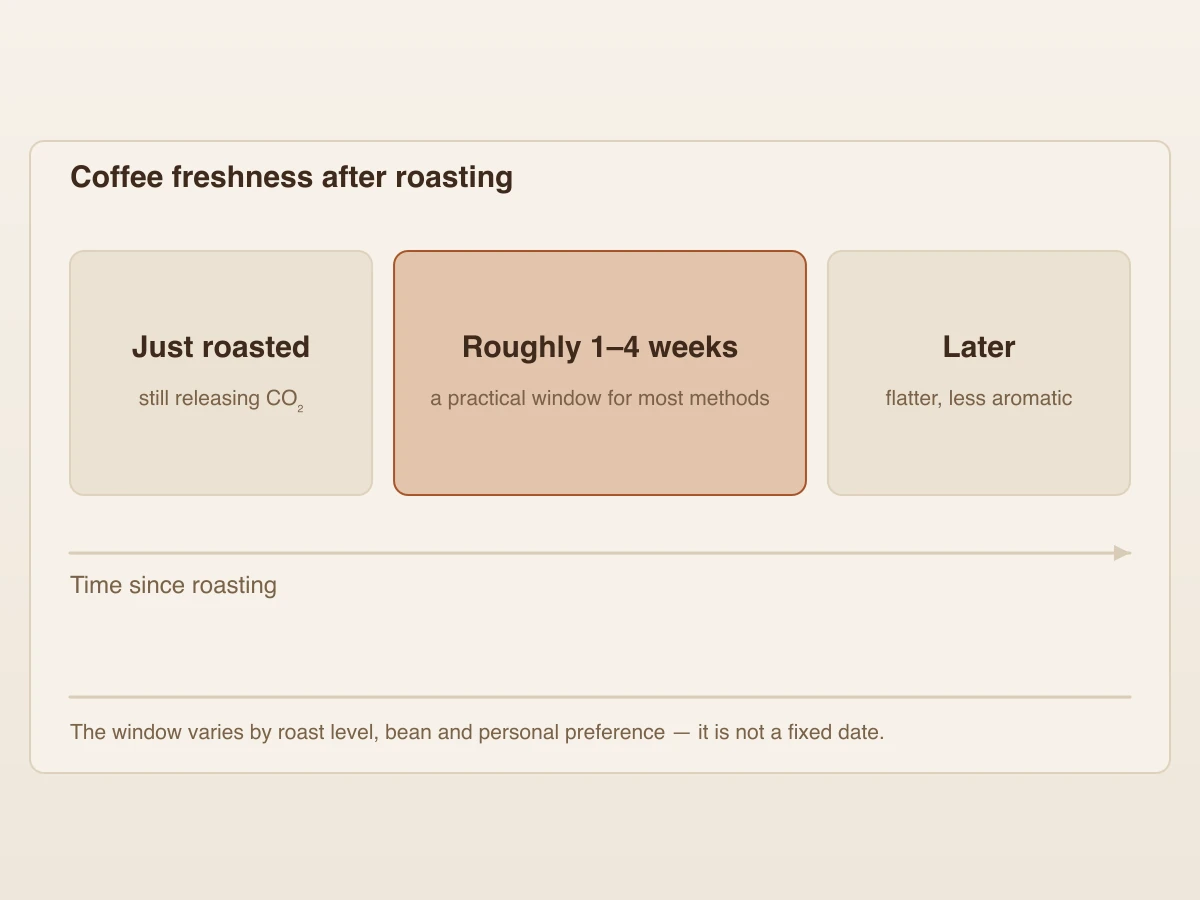
- A roaster's best-before or roasted-on date is that roaster's judgement about that coffee. Roasters commonly advise drinking coffee within some weeks of roasting; no study read establishes a number that holds for coffee in general.
No days and no weeks: what storage advice here leaves open
CoffeeHQ explanation
It gives no number of days or weeks for which any kind of coffee stays good, and no shelf life for instant coffee, capsules or concentrates. It does not say frozen coffee tastes as good as fresh, since the one trial judged by smell. It does not rank containers. It does not say how long ground coffee lasts. And it does not cover brewed coffee kept warm or milk drinks left standing, which are best drunk when made and about which nothing was read.
What to do next
- Why coffee goes stale — The measurements behind this page: gas loss by roast degree, what grinding does, and the packaging study.
- Store and freeze coffee, step by step — The portioning and sealing routine set out as a technique.
- Airtight or vacuum storage? — What the storage study tested and what it left untested.
- Resting roasted coffee — The other end of freshness: coffee that is too new.
- Instant coffee — The humidity study in more detail, and why instant coffee is so dry to begin with.