Foundational
Coffee sensory and tasting basics
Aroma, acidity, body, balance and finish, explained in plain language — plus how professional cupping works and how to run a useful tasting at home.
In short
A bag says blueberry, jasmine and milk chocolate. The cup tastes of coffee. Both are true, and the gap between them is not a trick or a failure of your palate. Tasting notes use a particular vocabulary for a particular set of sensations, and once you know which sense each word belongs to, most of them become checkable.
This guide sets out how flavour is put together, what the main tasting words mean and how far each has been pinned down, how the trade's two reference tools were made and what they cannot do, the families that flavour notes fall into, what is commonly mistaken for what, and what pushes a taster's judgement about without their noticing. It ends with exercises for testing any of it yourself.
The routes by which a coffee reaches you
Sourced
The Specialty Coffee Association's 2024 tasting standard divides the experience into sections by the sense involved. This is its division, in the order a cup presents them.
Smell, through the nose
Breathing in over the dry grounds or the cup carries odour to the nose from outside. The standard calls this the orthonasal route, and it names what arrives by it fragrance for the dry grounds and aroma for the brew.
Taste, on the tongue
The tongue reports a small number of tastes. The standard's own reference list has five: sweet, sour, salty, bitter and umami. Acidity, in its vocabulary, is the perception of sour taste.
Smell again, from the mouth
With coffee in the mouth, odour travels from the back of the mouth up into the nose as you breathe out. This is the retronasal route. Berry, flower, nut and smoke all arrive this way, though they seem to be in the mouth.
Touch
The mouth registers the liquid's weight and thickness, its texture, and drying. The standard groups these as mouthfeel, and it places astringency here, as a feeling and not a taste.
What stays
After the coffee is swallowed or spat out, taste and retronasal smell continue from what remains in the mouth and throat. That is aftertaste, and it has a length as well as a character.
A diagram of the standard's categories, not a measurement. The standard itself notes that flavour is perceived as a single impression because the brain combines the inputs; the skill of tasting is taking that impression apart again.
The tasting words, and how far each is pinned down
Sourced
Definitions are the 2024 standard's unless another document is named. Where a word has a physical reference, it comes from that standard or from the World Coffee Research lexicon.
- Acidity
- The perception of sour taste, which the standard says varies in intensity and in character. The earlier cupping protocol put the two-sidedness plainly: acidity is called brightness when it is liked and sour when it is not. The word names a sensation and does not tell you which acids are present. The lexicon's reference for sour is a weak citric acid solution.
- Sweetness
- Defined in the 2024 standard as sweetness perceived by taste or by retronasal smell, which is a careful way of saying it need not come from sugar. The 2015 protocol had attributed it to carbohydrates in the cup. A sensory study of drip coffee, which CoffeeHQ has read only in abstract, measured the simple sugars in the brew and reported none at a level a person could taste; its authors suggest that sweetness in coffee comes from other tastes being masked or from aromas people associate with sweetness. That is one study's suggestion, read at one remove. The word is in daily use; what causes the sensation is not settled by anything read here.
- Bitterness
- A basic taste, present in all coffee. The lexicon's reference for it is a caffeine solution at four strengths; the standard's is simply dark-roasted coffee. In the one large panel study CoffeeHQ has read on brewing variables, bitterness rose with the strength of the brew. Which compounds carry it is a chemistry question this page does not answer.
- Body, or mouthfeel
- Touch, not taste. The standard's mouthfeel covers thickness, texture and other tactile sensations, and its check-list has five words: rough, oily, smooth, mouth-drying and metallic. The lexicon's references for thickness are a five per cent sugar solution and tomato juice, which says something about how small the differences between coffees are on any wider scale of liquids.
- Astringency
- The drying, puckering feeling of strong tea, which the lexicon calls mouth-drying and references with a dilute alum solution. It is filed under mouthfeel in both documents. It is very often reported as bitterness, and it is a different sensation from a different sense.
- Aftertaste, or finish
- What continues after the coffee has left the mouth. The earlier protocol scored it for how long pleasant flavour lasted; the present standard records its intensity and its character separately from whether the taster likes it.
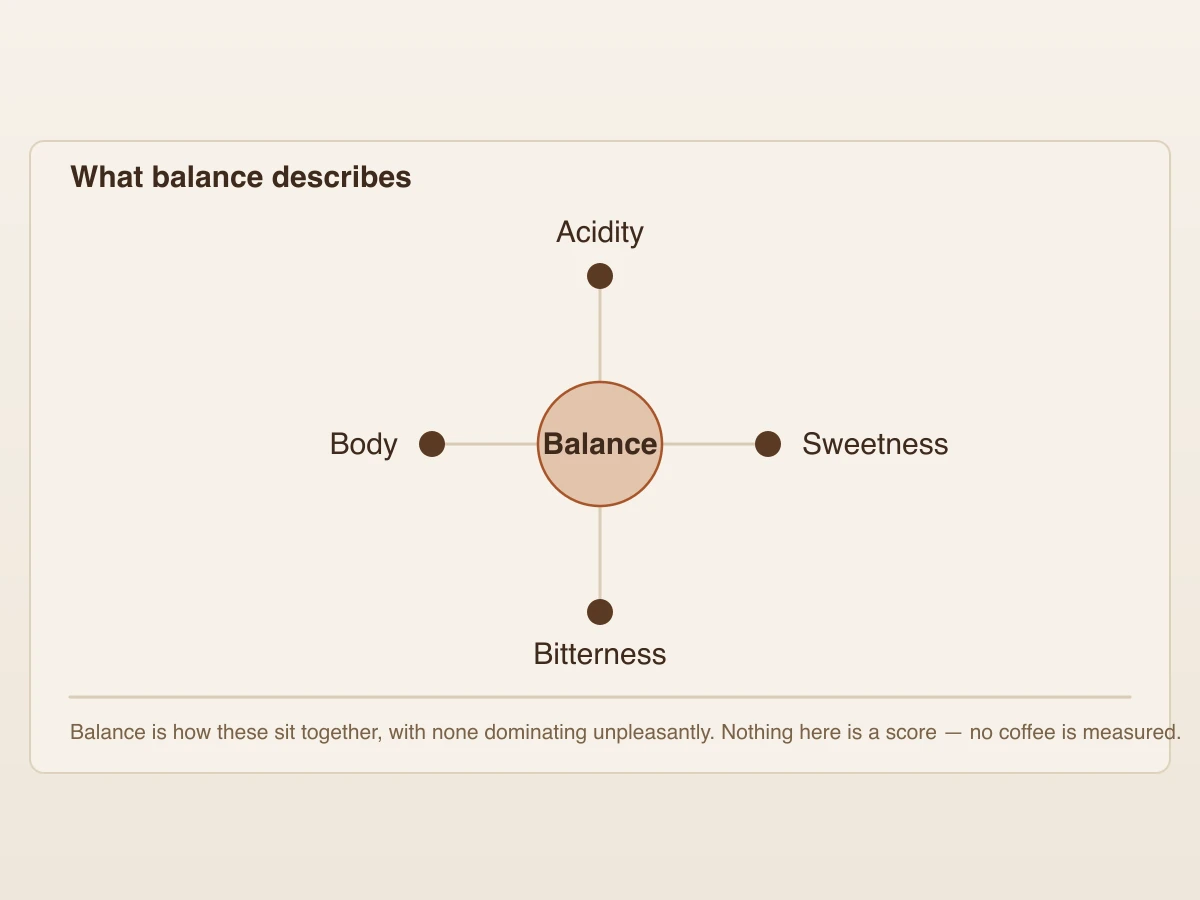
- Balance, clarity and cleanliness
- These are judgements, not sensations. The 2015 protocol scored balance as how well flavour, aftertaste, acidity and body fitted together, and clean cup as the absence of interfering impressions. The 2024 standards no longer score either on its own line: the present system records what is there in one assessment and how much it is liked in another. Clarity, in the sense of flavours being easy to tell apart, appears in neither document and is a taster's working word.
The lexicon and the wheel: how they were made, and what they are not
Sourced
Two reference tools sit behind most professional tasting notes. The World Coffee Research Sensory Lexicon, first published in 2016, lists 110 attributes found in coffee. Each has a definition, one or more physical references that can be smelled or tasted, and for most of them an intensity on a fifteen-point scale. Blackberry, for example, is referenced by a named blackberry jam at a stated intensity. The point of the references is that two trained people in different places can mean the same thing by a word.
The lexicon says what it is for and what it is not. It describes and measures; it has no categories for good or bad and cannot rank coffees. It was built by trained panels from 105 arabica samples, none of them defective, so it is not a tool for faults. It calls itself unfinished. Its references are largely branded products sold in the United States, which it acknowledges as a limitation. And its intended users are trained panels: it describes panels of five to seven people training for six to nine months before their scores agree, tasting four to six coffees in a session because coffee's bitterness tires the palate, and tasting each coffee three times blind.
The Coffee Taster's Flavor Wheel of 2016 is a picture of that lexicon. The paper that describes its construction is specific about how it was drawn. Seventy-two people, twenty-nine trained descriptive panellists at a university and forty-three coffee professionals, each sorted ninety-nine of the lexicon's words into groups on a web page. Nobody tasted anything. Statistical clustering of how often words were grouped together produced nine main classes, and a second technique placed classes that were sorted as similar next to each other around the circle. The organisers then added or moved a few umbrella terms to make the result fit a wheel.
So the wheel records how experienced tasters think the words relate. It is not a map of how often each flavour occurs, it does not say which flavours go with which coffees, and a position near the centre is a broader word, not a more important one. It replaced a wheel drawn in 1995. Both the lexicon and the wheel are described by their makers as living documents.
What a flavour note is, and is not
CoffeeHQ explanation
A note such as blueberry means that some of the aroma of this coffee resembled blueberries to the person who wrote it. Nothing was added. On a bag, the word was usually chosen by a roaster tasting in the ordinary way, not by a trained panel scoring against the lexicon's jam, so it is one person's or one small team's comparison, and another taster may reach for a different fruit and be equally right.
The wheel is read from the centre outwards: decide the class first, and narrow only as far as you are sure. Stopping at the class is respectable. The present assessment standard does the same thing formally. Its form asks tasters to tick up to five broad descriptors from a fixed list, and treats each inner word of the wheel as a category that contains the outer ones.
The flavour families
Sourced
These are the nine main classes the wheel's construction produced, with the narrower words the paper lists under each. Where a coffee's country, process or roast is said to favour a family, that is the trade's habit of description, and this page does not repeat it: nothing read here tests it.
- Floral
- Jasmine, rose, chamomile and black tea. The tea-like word sits here in the wheel and not under body, which is where drinkers often put it.
- Fruity: berry, dried fruit, citrus and other fruit
- The largest class. Berry holds blackberry, raspberry, blueberry and strawberry; dried fruit holds raisin and prune; citrus holds grapefruit, orange, lemon and lime; the rest, from apple and peach to pineapple and coconut, is gathered as other fruit.
- Sour and fermented
- Two neighbours grouped together: the sour words, which name particular acids such as citric, malic and acetic, and the alcohol and fermented words, winey, whiskey, fermented and overripe. The wheel places these beside fruit, which is how tasters sorted them.
- Green and vegetative
- Olive oil, raw, under-ripe, peapod, fresh, hay-like, herb-like and beany. Some of these are prized in small amounts and some are usually read as a sign of unripe fruit or an undeveloped roast.
- Other: papery, musty and chemical
- A class the organisers named for want of an umbrella word. It holds stale, cardboard and papery; woody, mouldy and the two musty words, one earthy and one dusty; and a chemical group including medicinal, rubber and petroleum. Earthy, in the lexicon's definition, is the aromatic of decaying vegetation and damp black soil.
- Roasted
- Tobacco and pipe tobacco; burnt, with acrid, ashy, smoky and brown roast beneath it; and cereal, with grain and malt. The wheel keeps all of these apart from the nut and cocoa words. The lexicon defines roasted itself as the dark-brown impression of something cooked by dry heat, and adds that it does not include bitter or burnt notes.
- Spices
- Pungent and pepper on one side; brown spice, with anise, nutmeg, cinnamon and clove, on the other. These are aromas found in the coffee itself, not anything added to the pot.
- Nutty and cocoa
- Peanuts, hazelnut and almond; chocolate and dark chocolate. Sorted together by tasters and placed between the spices and the sweet words.
- Sweet
- Brown sugar, with molasses, maple syrup, caramelised and honey; vanilla and vanillin; and two general words, overall sweet and sweet aromatics. These are smells that people call sweet, which is part of why a cup can seem sweet with very little sugar in it.
What gets mistaken for what
CoffeeHQ explanation
The distinctions follow the definitions above. The suggested checks are CoffeeHQ's and are ways to look, not diagnoses.
- Called bitter, when it is sour
Usually because: People new to light roasts often use bitter for any strong, unwelcome taste. They are different basic tastes with different references: citric acid for one, caffeine for the other.
Change first: Taste a little citric acid or lemon juice in water beside a strong black coffee, to fix the two words.
- Called bitter, when it is drying
Usually because: Astringency is a tactile feeling on the tongue and gums. It often accompanies bitterness and is filed under mouthfeel, not taste.
Change first: Notice whether your mouth feels dry and rough after swallowing, separately from what you tasted.
- Called sweet, when it smells sweet
Usually because: The standard allows sweetness to arrive by taste or by retronasal smell. Caramel and vanilla are smells.
Change first: Pinch your nose, sip, and see how much of the sweetness is still there before you let go.
- Called fruity, when it is only sour
Usually because: Fruit is aroma; sourness is taste. A cup can have either without the other, and the wheel keeps the fruit words and the sour words in separate classes.
Change first: Use the same nose-pinch: sourness stays when the nose is closed, fruit arrives when it opens.
- Called roasty, when it is burnt
Usually because: The lexicon defines the two apart. Brown roast is a rich, round impression of darkness, associated with toasted, nutty and sweet; burnt is the impression of something over-cooked, which can be sharp, bitter and sour. The wheel files brown roast under burnt all the same, which shows how close tasters hold them.
Change first: No brewing change turns one into the other; it is a property of the roast.
- Called earthy, when it is papery or mouldy
Usually because: All three sit in the same class of the wheel and are easy to merge. Stale, cardboard and papery are grouped apart from the musty words, and the present standard counts mouldy among its three sensory defects.
Change first: Ask whether it reminds you of soil, of cardboard, or of damp. They point to different histories for the coffee.
What moves a taster's judgement
Sourced
Perception shifts with circumstances, and professional practice is built around that. The lexicon limits a session to a handful of coffees because the palate tires. The earlier cupping protocol asks for a quiet, well-lit room free of other smells and has tasters score as the cup cools, because, in its words, perceptions change as the temperature falls. The present standard tells tasters not to be influenced by others at the table.
Information matters as much as fatigue. In an experiment in São Paulo, 180 drinkers of speciality coffee tasted one coffee three times from bags that differed only in the processing line. With the word fermentation on the bag they expected it to be the most acidic, liked it least, and said the same after tasting it. Blind tasting exists because of effects like that one.
Temperature is a smaller influence than is often said, at least on liking. In a study of 118 consumers tasting one black coffee between 56 and 71 degrees Celsius, the temperature in the cup had little effect on whether people judged flavour intensity, acidity and mouthfeel to be about right, and only a slight relation to how much they liked it. Most thought the temperature itself about right until the hottest cups. That study measured acceptance, not what a trained taster can detect as a cup cools, and it used a single coffee. Its authors note that studies with trained panels have found temperature to matter a good deal, over much wider ranges than theirs.
Even trained experts are not instruments. In a study of forty-six experienced tasters in five countries describing eight espressos three times each, thirty-nine chose similar descriptors each time and seven did not; the words in use also differed between countries. Agreement is something panels train for over months. It is not what one person's notes on one morning provide, and that is the fair way to read a bag, a review and your own notebook alike.
Why a note cannot be read off the label
CoffeeHQ explanation
What ends up in the cup has passed through the plant, the processing, the roast and the brewing, and none of these acts alone. The lexicon's own introduction makes the point when it lists what a coffee has experienced since leaving the tree: processing, drying, milling, storage, transport, roasting and brewing.
The trade has well-worn expectations that link a country, a process or a roast to a family of flavours. CoffeeHQ's pages on processing and on individual countries looked for tests of those expectations and found very few, and where a controlled comparison was found the result was closer than the shorthand suggests. Treat an origin or process on a label as a reason to be curious, and the tasting as the evidence.
Exercises that calibrate your own palate
Sourced
The references are the ones the Specialty Coffee Association's descriptive standard gives for the basic tastes. They are ordinary foods; make them with clean utensils and drinking water, and taste a sip, not a glass. Use only ingredients sold as food. The published references for bitter, drying and metallic are solutions of caffeine, alum and potassium chloride made up for trained panels; these exercises do not use them and you should not improvise them.
Fix the basic words
- Change
- Make three jugs from one litre of drinking water each: about five grams of white sugar in the first, two grams of table salt in the second, and less than half a gram of food-grade citric acid in the third. The standard states them as 0.52, 0.20 and 0.04 per cent.
- Keep the same
- The same water at the same temperature for all three
- What to notice
- Sweet, salty and sour, each on its own and each faint. These are the standard's reference strengths, and their weakness is the lesson: the tastes in coffee are small sensations.
Separate taste from smell
- Change
- Take a sip of coffee while pinching your nose shut, then release it and breathe out through your nose.
- Keep the same
- The same sip
- What to notice
- With the nose closed you have taste and mouthfeel only. What arrives when you let go came by the retronasal route.
Find a class by contrast
- Change
- Brew two coffees you expect to differ, the same way, and taste them side by side.
- Keep the same
- Brewer, ratio, grind setting, water and the temperature you taste at
- What to notice
- Do not look for named fruits. Decide which is more sour, which is heavier, and which of the wheel's nine classes each leans towards. Then check whether the labels would have led you to expect it.
Taste it cooling
- Change
- Taste the same cup three times as it cools, without adding anything.
- Keep the same
- The same cup, the same spoon or sip size
- What to notice
- Write down what changes and what does not. Cupping protocols score in this order for a reason, and the consumer study above suggests the effect on liking is small; this is how you find out what it is for you.
No flavour map, no molecule map: what is left out
CoffeeHQ explanation
It does not say which flavours belong to which countries, varieties, processes or roasts. It does not say which compounds cause which flavour: the lexicon states that as a research aim, not a result, and the chemistry guide explains how little can be mapped. It does not say that sweetness in coffee is or is not sugar; the documents read disagree. It gives no tasting note for any coffee, because nobody at CoffeeHQ has tasted one for this site.
It also does not reproduce the flavour wheel or the lexicon's reference list. Both are published by their owners, free to read, and are better consulted there than paraphrased here.
What to do next
- Tasting Lab — A worksheet for your own notes, a triangle test, and comparison plans that say what to hold constant.
- Coffee cupping explained — The trade's method for comparing coffees, step by step, with each figure attributed to the protocol it comes from.
- Coffee chemistry — What is in the seed and the cup, and why a compound cannot simply be matched to a flavour word.
- Coffee Expert level 10: sensory — The same ground as a lesson, with self-checks and exercises to run.
- Coffee processing — What is and is not established about processing and taste, family by family.