Foundational
Extraction basics
Strength and extraction as two different things, what studies found about sour and bitter, unevenness, and what a filter holds back.
In short
Brewing dissolves part of the ground coffee into water. Two different numbers describe the result, and most confusion about brewing comes from treating them as one. Strength is how much dissolved coffee is in each mouthful. Extraction is how much of the dry coffee was dissolved to get there.
A cup can be strong and little extracted, or weak and heavily extracted. They are changed by different things, they go wrong in different ways, and a brewer who can tell which one is off has most of what this subject offers in practice.
Two numbers, not one
Sourced
Researchers who study brewing describe a cup by its total dissolved solids, the share of the drink by weight that is dissolved coffee, and its extraction yield, the share of the dry grounds that ended up in the drink. The two are tied together by the recipe: for a given amount of coffee and water, more extraction means a stronger cup. Change the recipe and they come apart.
A study at the University of California, Davis brewed one coffee to planned combinations of the two and had a trained panel describe each. Both changed what the panel tasted; by the authors' account strength had the greatest impact, and extraction a lesser but noticeable one. That is one coffee, one drip brewer and one panel, but it is a useful corrective: much of what is blamed on extraction in a kitchen is a matter of how much coffee went in.
The practical reading is simple. If a cup tastes right but thin, it needs more coffee for the water, and no change to grind or time. If it tastes wrong at any strength, extraction is the place to look.
Sour, bitter and the story usually told
Accounts differ
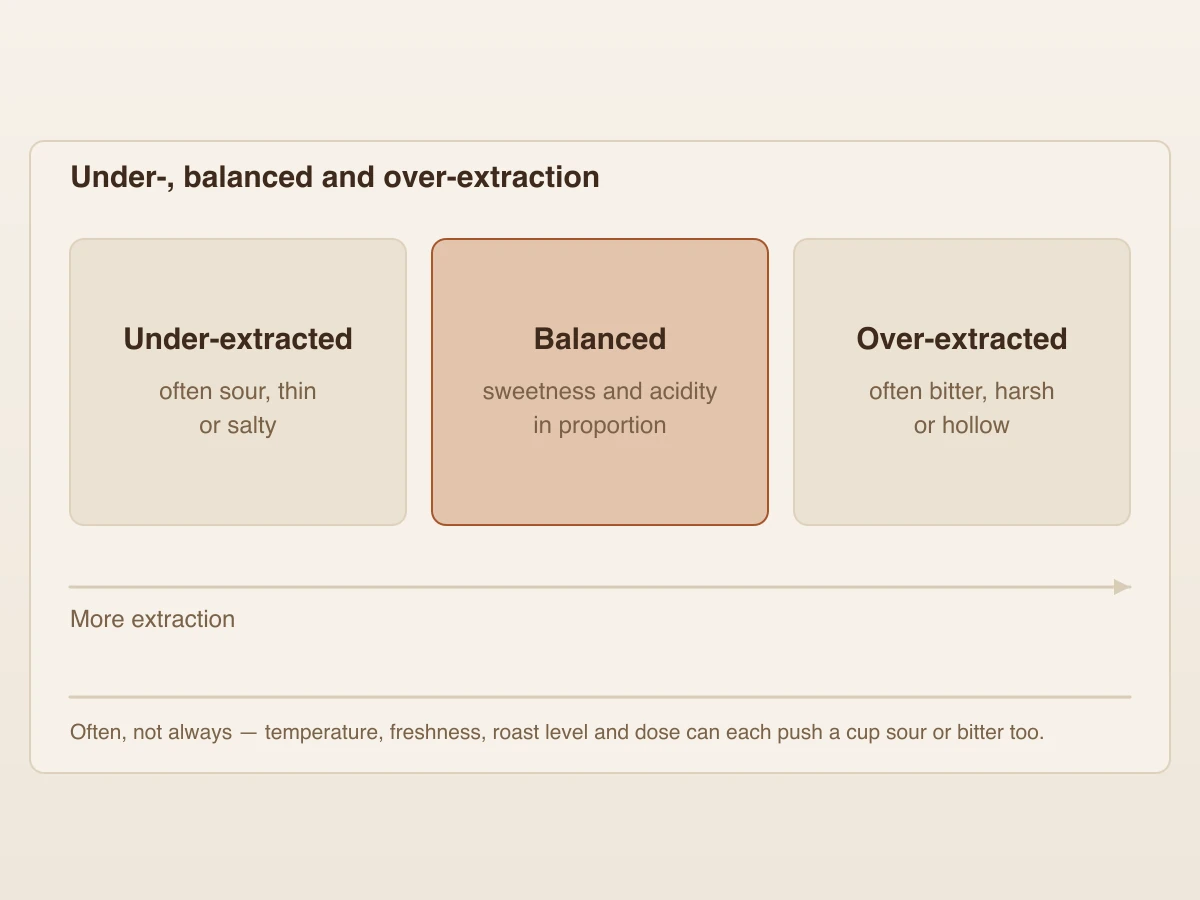
The usual account says a short brew tastes sour and a long one bitter, because sharp-tasting compounds dissolve quickly and bitter ones slowly. It is a serviceable rule for correcting a cup, and brewers have used it for decades. As a description of what dissolves when, it has been tested and does not hold up neatly.
When drip coffee was collected in a fresh carafe every thirty seconds as it brewed, a trained panel found the earlier fractions both more sour and more bitter than the later ones, and the later ones sweeter and more floral. That result was read here from the paper's abstract. The early liquid is far more concentrated than the late liquid, so the fractions do not show a tidy sequence of flavours leaving the coffee in turn.
The Davis study of whole cups points the same way. Across its planned combinations, bitterness and astringency rose with strength and showed no statistically significant link to extraction, while sourness rose with strength and fell as extraction increased. Its authors write that the classic chart, which places bitter at high extraction, could be misleading on this point. It is one coffee and one brewer, and it does not make the familiar rule useless, but it does mean a bitter cup is as likely to be too strong as too far extracted.
So this page treats the rule as a rule of thumb about whole cups and no more. A cup that is sharp and thin often improves with more extraction. A cup that is harsh and drying is commonly treated by extracting less, and on the evidence above making it a little weaker is at least as reasonable a first move. Neither is guaranteed, and several things that are not extraction produce the same tastes.
What a brewer can change
Widely documented
| Variable | Typical range | What moving it does |
|---|---|---|
| Ratio of coffee to water | Sets strength directly | In full immersion it is close to the only control over strength; see the section on immersion below. |
| Grind | Finer generally extracts more and slows flow | In espresso the trend reversed at the finest settings in one study, run at six bar on one machine and grinder, which its authors put down to uneven flow. |
| Time and flow | Longer contact generally extracts more | In a drip brewer or espresso machine, time is largely a consequence of the grind. |
| Water temperature | Hotter water generally extracts faster | Once strength and extraction were held fixed, a panel could barely tell brewing temperatures apart. |
| Agitation | Stirring or turbulent pouring generally extracts more | No study read for this page measured it. |
Directions only, and they interact. How far any change moves a cup depends on the brewer, the grinder and the coffee, and none of these has a correct setting.
Steeping behaves differently from pouring through
Sourced
In a French press or a cupping bowl the grounds sit in all of the water. A model of that arrangement, tested against measurements by the same Davis group, found that extraction settles at about the same level whatever the ratio, around 21 per cent in their one-litre brews and a little higher in cupping bowls, while strength falls in step as more water is used. Their fitted constant barely changed with grind size, roast level or brewing temperatures between 80 and 99 degrees Celsius.
Their conclusion is unusually direct for a research paper: full immersion gives precise control over strength and little control over extraction, so the ratio is the thing to attend to. That describes a brew left to reach equilibrium, and the paper says how long that took: in their one-litre brews strength kept rising for about twenty minutes before levelling off. A steep poured off after four minutes has not got there, so for a brew that short, time and grind still have something to do.
When water passes through a bed of coffee instead, fresh water keeps arriving, and how much it removes depends on how long it stays and what path it takes. That makes pour-over and espresso more adjustable and far easier to get uneven.
When the bed does not extract evenly
Accounts differ
Water takes the easiest route through a bed of grounds. Where it finds one, the coffee along that route is extracted heavily and the rest hardly at all, and the cup is an average of the two. Brewers call the extreme case channelling. It is the usual explanation for a cup that tastes sharp and harsh at once, and for espresso that will not come right at any grind. The espresso study below says the same of its uneven shots, as an expectation and not as something it tested.
The best-known evidence is a study of espresso that combined a mathematical model with measured shots. The model predicted that grinding finer should always extract more. The measurements showed extraction rising and then falling at the finest settings, which the authors say strongly suggests parts of the bed clogging so that water flowed through only some of it. Nobody saw inside the bed; the conclusion is drawn from the gap between model and measurement. The shots were made in one café with one coffee, one grinder and one machine, at six bar because the usual nine clogged at fine settings. The authors measured extraction and note that differences in flavour were noticed but not quantified.
What follows from this in a kitchen is practice, not established fact: distribute the grounds evenly, pour gently, and if adjusting the grind makes a brew swing from one fault to the other without settling, suspect evenness before changing the grind again.
What a filter holds back
Sourced
A filter decides what, other than dissolved coffee, reaches the cup: oil and fine particles. One laboratory measured two oil-borne compounds, cafestol and kahweol in their ester forms, in coffee made several ways. Boiled coffee carried the most, followed by French press; moka and espresso sat in between; paper-filtered and instant coffee carried the least. A later review of earlier measurements reports the same ordering and attributes it to paper retaining most of the oil.
That is a measurement of what is in the cup. It is common to add that paper gives a cleaner, lighter-bodied cup and metal a heavier one, and the reasoning is plausible, since oil and fine particles are what a metal mesh lets through. No tasting study comparing filters was read for this page, so it is given here as the trade's description. Nothing was read on cloth filters at all.
Two further sources put figures on the oil and a caution on the ordering. A review of coffee lipids reports that less than 0.2 per cent of the coffee's lipids pass into filtered coffee made in a household machine, against 1 to 2 per cent into an espresso. And a compilation of published measurements of the two oil-borne compounds notes how widely the figures spread within each method: the lowest values reported for boiled coffee overlap the highest reported for filtered. It puts that down to differences in how samples were prepared and analysed. The ordering of methods is robust as an average and should not be read as a fixed gap between any two cups.
On the physics of the filter itself a little can be said, at second hand. The same compilation reports three studies of where the oil goes in a paper-filtered brew. An early one found 0.4 per cent of the coffee's lipids in the cup, 9.4 per cent held in the paper and 90.2 per cent left in the spent grounds, with the same make-up of lipids in the paper and the grounds. A study of 2017 found much the same for the two oil-borne compounds: about a tenth of one per cent in the brew, 11 to 14 per cent in the paper and 86 to 89 per cent in the grounds. The compilation's reading is that the oil is mostly never released from the bed of coffee, which does the greater part of the filtering, and that the paper holds a smaller share than is often said. It adds that a 2018 study by the same group found more porous papers letting more of the compounds through, and the fineness of the grind changing how much of them, and of the dissolved solids, passed. None of those three studies was opened. No source read gives the pore size of any coffee filter paper, compares bleached with unbleached or thick with thin, or measures a metal mesh or a cloth in the same way; figures quoted for a particular paper or mesh are makers' figures or estimates, and none is repeated here.
From what you taste to what to try
CoffeeHQ explanation
- Tastes right but thin or watery
Usually because: A strength problem. There is too little coffee for the water.
Change first: Use more coffee, and leave the grind alone.
- Sharp, thin and quickly gone
Usually because: Often too little extraction, though a very light roast tastes this way however it is brewed.
Change first: Grind a little finer and taste again.
- Harsh, drying and lingering
Usually because: Often put down to too much extraction, though in one panel study bitterness followed strength instead, and a very dark roast tastes this way however it is brewed.
Change first: Grind a little coarser and taste again; if that does not help, use a little less coffee.
- Sharp and harsh together
Usually because: Possibly an uneven bed, with some coffee overworked and some barely touched.
Change first: Improve how evenly the coffee is ground and wetted before changing the grind.
What this page leaves out
CoffeeHQ explanation
It gives no target for strength or extraction. The ranges brewing charts mark as ideal are conventions drawn from panels, and they are discussed on the page about measuring. It does not say which compounds cause which taste, because the one study of fractions read here does not support a simple answer. It does not rank filters by taste. And it reports no result from an espresso study as though it applied to filter coffee, or the reverse.
What to do next
- Coffee chemistry — What it is that dissolves: the compounds in roasted coffee and how much of each was measured in a cup.
- Measuring strength and extraction — What a refractometer reads, the arithmetic, and why no reading guarantees a good cup.
- What the models of extraction say — The fast and slow processes inside a coffee particle, and how far a model can be trusted.
- Grinding and particle size — The control used most, and what has been measured about it.
- Brewing variable explorer — Shows the direction each variable pushes strength and extraction for your method.
Related
- Coffee tastes too sour
- Coffee tastes too bitter
- Extraction science: solubility, diffusion and total dissolved solids
- Blooming coffee
- Pulse pouring
- Rinsing a paper filter
- Metal coffee filter
- Coffee tastes weak or watery
- Coffee tastes too strong
- Pour-over brew stalls or drains too slowly
- Uneven coffee bed after pour-over brewing
- Too much sediment in French press coffee
- Make my coffee better
- Stronger, weaker or better brew assistant
- How brewing methods change the taste
- Brewing variable explorer