Foundational
Coffee-to-water ratio explained
What the coffee-to-water ratio is, why it varies by brewing method, and how to use it to control strength.
In short
The coffee-to-water ratio is how much ground coffee you use for a given amount of water. It is the main control over strength: more coffee for the same water gives a stronger cup, less gives a weaker one.
It is not the main control over whether coffee tastes sour or bitter. Those are mostly questions of extraction, which grind, time and temperature govern. Keeping the two ideas apart is the most useful thing to take from this page.
Two ways of writing the same thing
Widely documented
A ratio such as 1:16 means one part coffee to sixteen parts water by weight: 15 grams of coffee to 240 grams of water. The larger the second number, the weaker the brew. Grams per litre says the same thing the other way round: 60 g/L means 60 grams of coffee for every litre of water, and a larger number means a stronger brew.
To convert, divide 1,000 by one to get the other. A ratio of 1:16 is about 62 g/L; 60 g/L is about 1:16.7. Because the two scales run in opposite directions, it helps to say stronger or weaker instead of higher or lower.
Weigh both. A scoop of dark roast weighs less than a scoop of light roast, and a mug is not a unit. A gram of water is a millilitre, so a kitchen scale handles both.
Typical ratios, method by method
Typical range
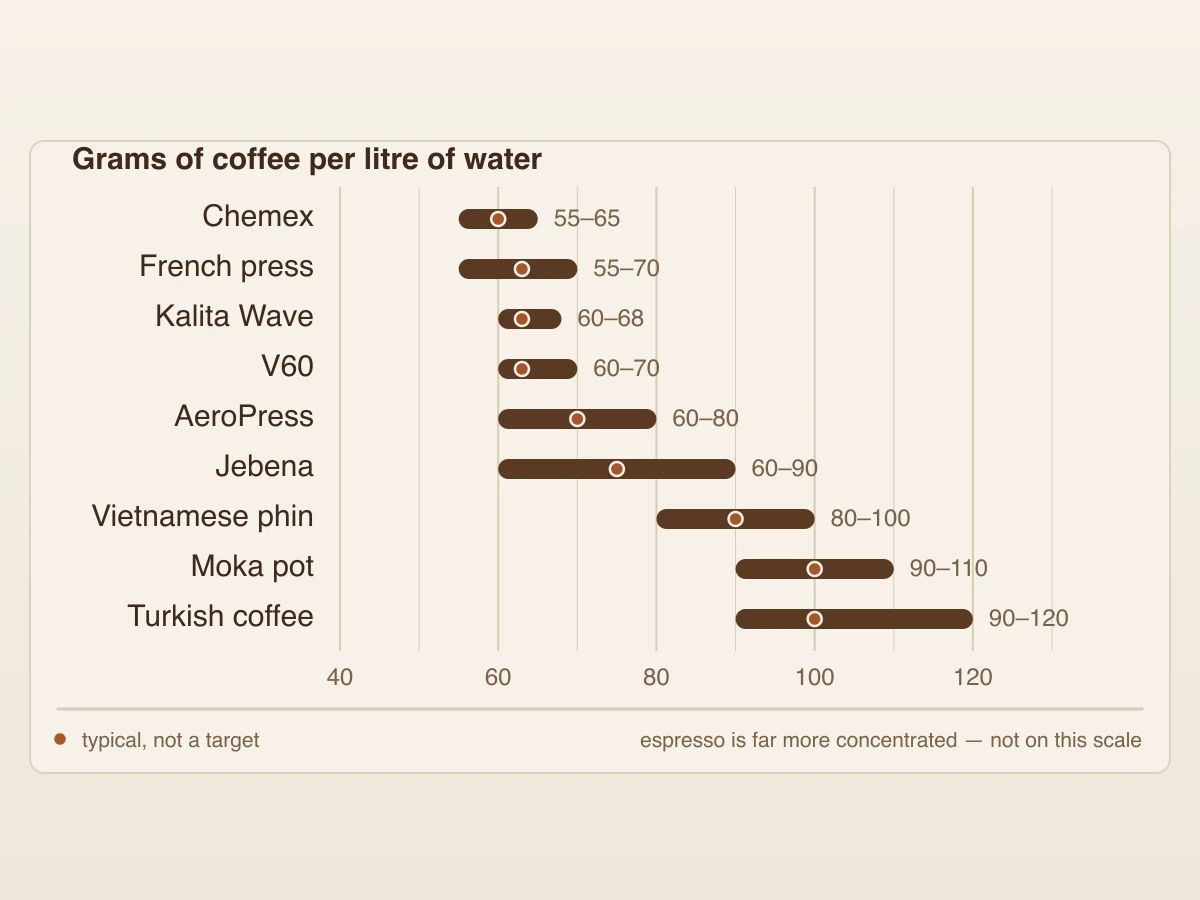
Each method has a range that suits how it extracts. These agree with the ranges on CoffeeHQ's individual method pages.
| Variable | Typical range | What moving it does |
|---|---|---|
| Pour-over and drip | About 55–70 g per litre (1:14 to 1:18) | |
| French press | About 55–70 g per litre (1:14 to 1:18) | The same range as filter; its heavier body makes it seem stronger. |
| AeroPress | About 60–80 g per litre as brewed | Many recipes instead brew a short concentrate and dilute it in the cup. |
| Moka pot | About 90–110 g per litre (roughly 1:9 to 1:11) | Set by the size of the basket and the base more than by choice. |
| Espresso | About 1:1.5 to 1:2.5, coffee in to liquid out | Measured against the weight of the drink, not the water put in. |
| Cold brew | About 100–150 g per litre (1:7 to 1:10), usually diluted before drinking | Recipes vary more here than for any other method. |
Starting ranges for typical use. Published recipes sit outside every one of these on purpose, and personal preference is a legitimate reason to do the same.
Where the familiar numbers come from
Sourced
The much-quoted figure of roughly 55 grams per litre for filter coffee comes from brewing standards developed by the coffee trade in the mid twentieth century and maintained since by the Specialty Coffee Association. They were expressed on a chart that plots strength against extraction and marks a central region as ideal.
More recent sensory research at the UC Davis Coffee Center has found that consumers fall into groups with different preferences, and that no single region of the chart is ideal for everyone. The traditional figure is a sound place to start. It is not a law.
Strength and extraction are different dials
CoffeeHQ explanation
Strength is how much dissolved coffee is in the cup. Extraction is how much of the ground coffee you dissolved to get there. A cup can be strong and under-extracted, which tastes intense and sour, or weak and over-extracted, which tastes thin and bitter.
The two are linked, which is where confusion starts. Add more coffee to the same water and you raise strength, but each gram of coffee now has less water to extract it, so extraction tends to fall slightly. That is why making coffee stronger by adding coffee can also make it taste a little sharper, and why the usual advice is to change ratio for strength and grind for taste.
Is it the ratio, or something else?
CoffeeHQ explanation
- Tastes right but watery
Usually because: Too little coffee for the water. Extraction is fine; there is simply not enough of it in the cup.
Change first: Use more coffee, or less water. Leave the grind alone.
- Good flavour but overpowering
Usually because: Too much coffee for the water.
Change first: Use less coffee, or simply add a little hot water to the cup.
- Sour, sharp or thin-tasting at a sensible ratio
Usually because: Too little taken from the coffee, a light roast, or water that was not hot enough. Changing the ratio will not cure it.
Change first: Grind finer.
- Bitter and drying at a sensible ratio
Usually because: More taken from the coffee than tastes good, or water that is too hot for the roast. If it fades when a little water is added to the cup, it was strength after all.
Change first: Grind coarser.
Taste what ratio does on its own
CoffeeHQ explanation
Three cups, three strengths
- Change
- Brew the same coffee at 1:15, 1:16 and 1:17, changing only the amount of water, or of coffee.
- Keep the same
- The coffee, the grind setting, the water temperature and, as far as you can, the technique.
- What to notice
- Mainly a change in intensity and weight. If one also tastes more sour or more bitter, that is the small knock-on effect on extraction described above.
What to do next
- Ratio calculator — Works out coffee or water for any ratio and tells you what the result means for the method.
- Extraction basics — The other half of the picture: what sour and bitter are telling you.
- Scale a recipe — Keeps the ratio the same when you change the number of cups.
- Espresso ratio calculator — Espresso ratios are measured differently and deserve their own tool.