Science
Extraction science: solubility, diffusion and total dissolved solids
A deeper look at what 'extraction' physically means, beyond the practical sour/bitter heuristic.
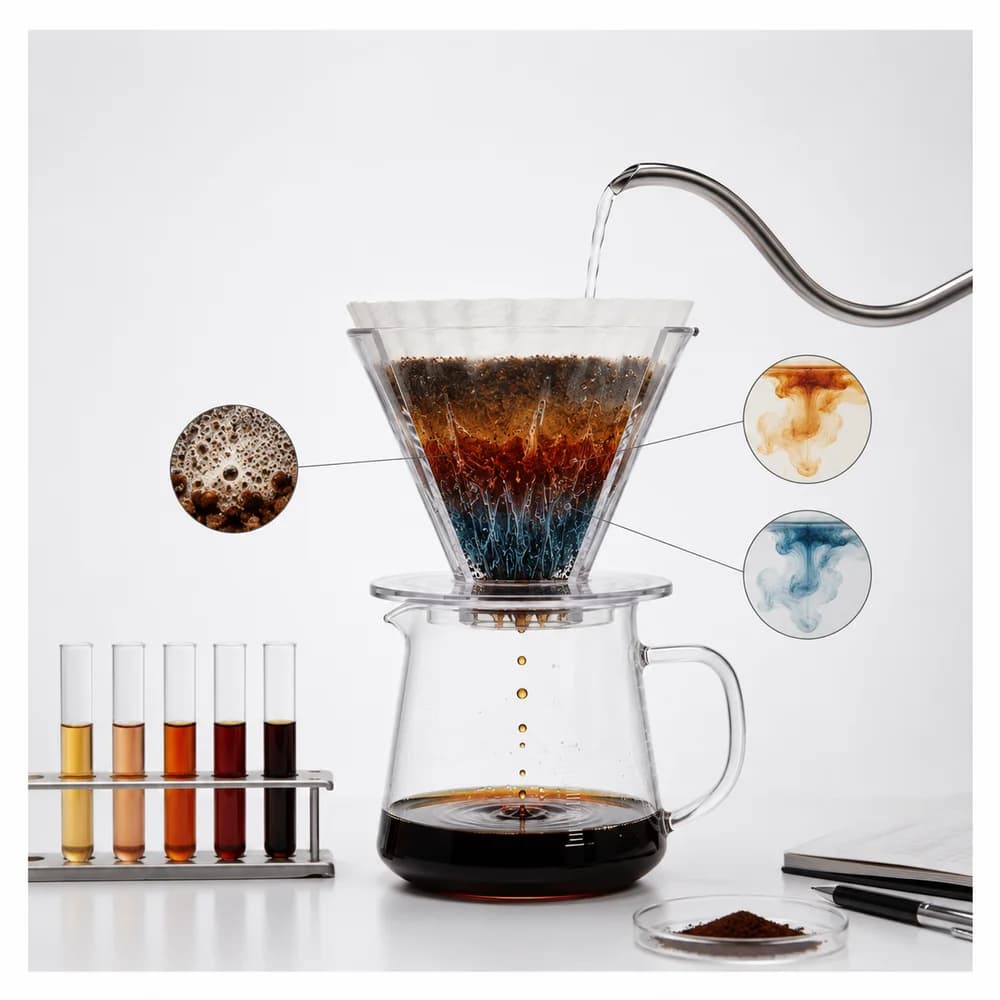
In short
Nobody can watch coffee dissolve inside a particle a fraction of a millimetre across. What is known about it comes from models: equations that describe what ought to happen, fitted to measurements of what comes out. This page sets out what three of them say.
A model is a simplification that has been checked against some data. It is worth knowing which data. Each of the three below was tested on a particular arrangement, and each says something useful about that arrangement and less about others.
Five things happening at once: a model in plain words
CoffeeHQ explanation
A model, put in plain words, of the processes the mathematical models below are built from. They are listed in the order a molecule of dissolved coffee meets them, though in a real brew all five run together.
Wetting
Water enters the bed and then the pores of each particle, pushing out air and gas. Nothing can dissolve from a surface the water has not reached.
Dissolving at the surface
Material on and just under the broken surfaces of a particle goes into the water quickly. This is the wash that makes the first liquid out of any brewer the strongest.
Diffusion from inside
Material deeper in has to work its way out through the particle's pores, driven only by the difference in concentration between inside and outside. This is slow, and slower the larger the particle.
The layer at the surface
Just outside each particle the water is richer in dissolved coffee than the water further off. The thinner that layer is kept, by stirring or by flow, the faster material leaves the particle.
Being carried away
In a steeped brew the dissolved coffee spreads through still water and the whole pot drifts towards a balance. In a brew where water runs through a bed, fresh water keeps arriving and the dissolved coffee is carried out with the flow.
A model in CoffeeHQ's words. The last step is the difference between immersion and percolation: steeping slows as the water fills up with coffee, while flow keeps the water at the particle fresh but depends on every part of the bed getting its share of it.
A fast process and a slow one
Sourced
The model most often cited treats a bed of ground coffee as having two kinds of space: the gaps between particles, and the fine network of pores inside each one. Dissolved coffee leaves a particle in two ways. Material on and near the surface dissolves quickly. Material deeper in has to travel out through the winding pores, which is much slower.
The paper read for this page analyses the simplest case, a small amount of coffee stirred in plenty of water, so that flow through a bed does not complicate things. Its authors show that the ratio of the fast timescale to the slow one is small enough to treat the two as separate stages, and that the simplified equations match both their full numerical solution and experimental data for that case. The same underlying model had earlier been shown to describe a packed bed.
This is the origin of the idea that a brew has a quick early phase and a long slow tail. It is a statement about the total amount of dissolved material over time. It says nothing about which flavours arrive when, and it should not be read as support for a sequence of tastes.
Why particle size matters in this picture
CoffeeHQ explanation
If part of the coffee dissolves from surfaces and part has to diffuse out from inside, two things follow from geometry alone. Smaller particles have more surface for their weight, so more of their coffee is in the fast portion. And they have less distance from centre to edge, so the slow portion is quicker too.
That is reasoning from the model's structure, set out here in CoffeeHQ's words; the paper itself fits its parameters to two specific grinds and does not state the general rule. It is consistent with the everyday observation that finer coffee extracts faster. It also explains why a spread of particle sizes matters: in the same brew, the smallest particles are far along while the largest have barely started.
A model of steeping to equilibrium
Sourced
A second model, from the University of California, Davis, ignores time altogether and asks where a full-immersion brew ends up if left long enough. It treats dissolved coffee as shared between the liquid and the grounds in a fixed proportion, described by one averaged constant.
Two predictions follow, and the authors' measurements matched both. Strength is roughly inversely proportional to the amount of water per gram of coffee. Extraction at equilibrium does not depend on that ratio; in their experiments it sat at about 21 per cent across a wide range, reached after roughly twenty minutes. The constant itself was insensitive to grind size, roast level and brewing temperature between 80 and 99 degrees Celsius.
The paper also makes a point about measurement. The traditional way of finding extraction, drying the spent grounds in an oven and weighing what is left, gives values that are too low at equilibrium, because the wet grounds still hold brewed coffee when they go into the oven.
A model of espresso that disagreed with the measurements
Sourced
A third study built a model of flow and dissolution in an espresso bed and compared it with real shots. The model predicted more extraction the finer the grind. The shots showed extraction peaking at an intermediate setting and falling at the finest. The authors read the gap as strong evidence that at fine settings water no longer passes evenly through the whole bed, and estimated from it how much of the bed was being missed.
This is the useful thing a model can do: when its prediction fails, the failure points at something the model left out. Here that was unevenness. The model has two fitted constants, and the measurements were made at six bar with one coffee, one grinder and one machine in a working café. It measured extraction and not taste; its authors write that two shots with the same extraction made at different grinds cannot have the same composition, and that a barista still has to taste.
How far each model reaches
CoffeeHQ explanation
- The two-timescale model
- Analysed in the paper read here for a stirred, dilute suspension. It describes how much dissolves over time, treated as one averaged substance, and nothing about individual compounds or taste.
- The equilibrium model
- Describes full immersion left to settle, which took about twenty minutes in the authors' brews. It is not a description of a steep stopped well short of that, and it says nothing about brews where water flows through a bed.
- The espresso model
- Assumes even flow through the bed, and its disagreement with experiment at fine grinds is the finding. It does not predict when unevenness will set in for a given machine or grinder.
What these models do not tell you
CoffeeHQ explanation
None of them predicts flavour. Each treats coffee as a single dissolving substance, or follows a handful of measurable compounds, while a cup's taste depends on hundreds. None gives a recipe. And none was tested across the range of grinders, brewers and coffees a home brewer might own, so their numbers describe the experiments and should not be carried over as settings.
What to do next
- Coffee extraction — The practical side: strength, extraction, unevenness and what to change.
- Measuring strength and extraction — How the quantities these models predict are measured, and with what error.
- Brewing science lesson — Works through these ideas with an exercise and self-checks.