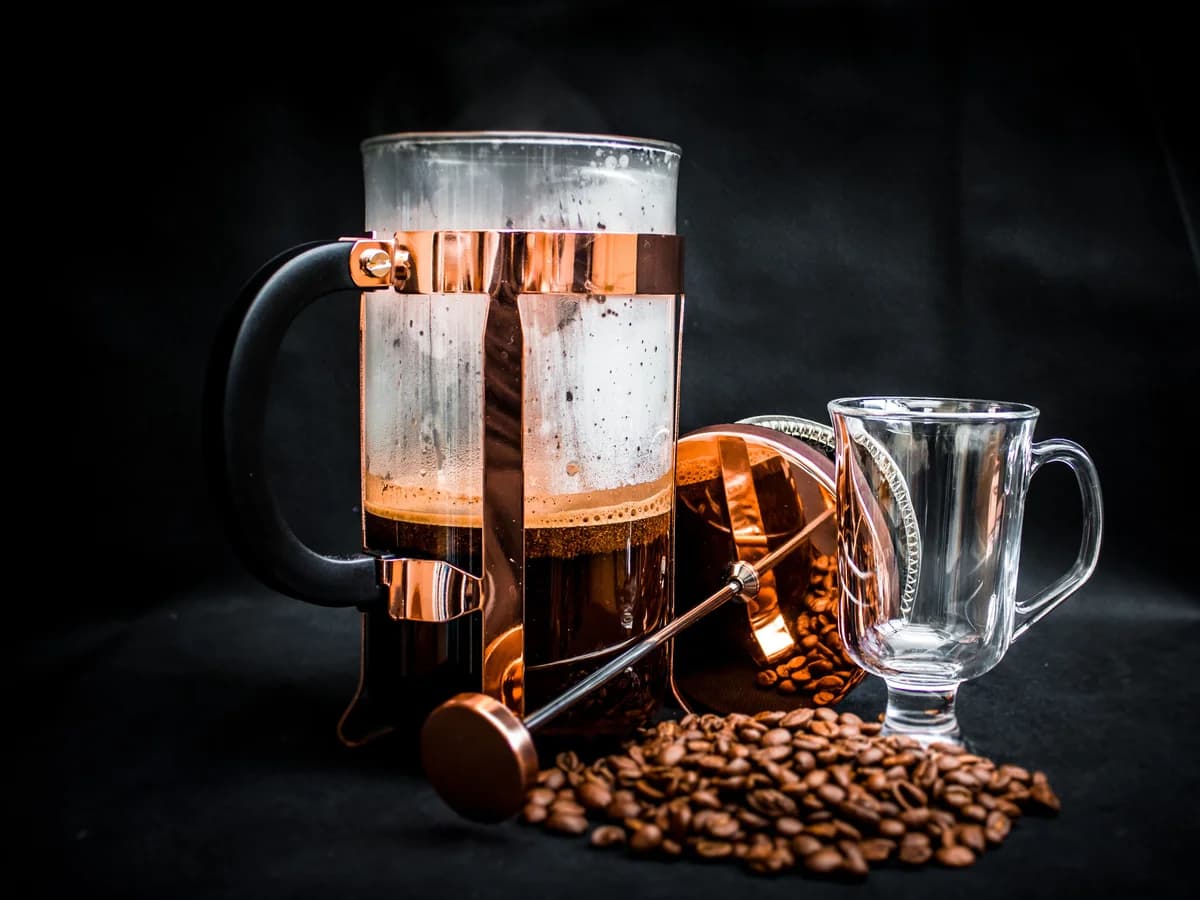
Coffee maker
French press
A full-immersion manual brewer using a metal mesh plunger, producing a fuller-bodied cup than paper-filtered methods.
In short
A French press is a jug with a plunger. Coffee steeps loose in hot water, and a mesh disc on a rod is pushed down to hold the grounds at the bottom while you pour. There is no paper, no electricity and very little to go wrong.
The choices that matter when buying one are the size, what the jug is made of, and whether you are prepared to clean it properly, because it is the messiest of the simple brewers.
The size on the box is not in mugs
Widely documented
Presses are sold by a number of cups, and the cup in question is a small one, much nearer a teacup than a mug. A press labelled for eight cups holds around a litre, which is three or four mugs. Check the stated volume, not the cup count.
A press works best reasonably full. A large press used for a single mug leaves a shallow layer of coffee that cools quickly and is awkward to plunge. If you usually brew for one, buy the small one; if you sometimes brew for four, a large press half-filled is the worse compromise.
Glass, double-wall steel and plastic
Tendency, not a guarantee
- Glass in a frame
- The classic design. You can see the brew, and replacement beakers are sold for common sizes. Glass loses heat faster and breaks, usually in the sink.
- Double-wall stainless steel
- Keeps coffee hot far longer and survives drops. You cannot see inside, and the coffee keeps extracting as it sits, so holding heat is not the same as holding quality.
- Plastic or ceramic bodies
- Plastic is light and unbreakable, which suits travel. Ceramic holds heat well once warmed but is heavy and as breakable as glass.
What the plunger is made of
Widely documented
Spiral plate
A sprung coil around the edge of a perforated plate. The spring presses against the jug wall so grounds cannot slip past the side.
Mesh screen
The fine woven disc that does the filtering. It is the part that frays or bends, and it is sold as a spare.
Cross plate
A rigid plate beneath the mesh that holds the stack flat and screws onto the rod.
The usual three-layer stack, top to bottom. It unscrews from the rod, which is the only way to clean the oil and fine grounds trapped between the layers.
Cleaning, which is the real cost
Widely documented
- Get the grounds out without the sink. A wet mass of coarse grounds can block a drain. Add a little water, swirl and tip them into a sieve, the compost or the bin.
- Wash after every use. Coffee oil left on the jug and mesh turns rancid and flavours the next brew. Hot water and a little washing-up liquid are enough.
- Take the filter apart regularly. Unscrew the stack and wash each layer. How often depends on use, but if the plunger smells stale, it is overdue.
- Replace the mesh when it stops sealing. A frayed edge or a dent lets grounds past the screen. A new mesh is a small spare part and restores the press.
What a maker's instructions say about glass and hot water
Sourced
From one large maker's instruction sheet for its glass presses. Other makers' instructions differ, and yours are the ones that apply.
- Use coarse-ground coffee only. The sheet gives the reason as safety, not flavour: a fine grind can clog the filter and create high pressure.
- Leave room at the top and stir with plastic or wood. It asks for at least 2.5 cm of space below the rim, and warns that a metal spoon can scratch or chip the beaker and cause it to break.
- Lower the plunger slowly, with minimal pressure. Hold the handle with the spout turned away from you and use little more than the weight of your hand. It asks for a brew of at least four minutes before plunging.
- Check the glass before each use. A beaker that is scratched, cracked or chipped should not be used; a replacement is fitted in the same frame.
- Keep it off the hob and away from children. These presses are not for stove-top use, and the sheet asks that children are kept away while one is in use.
The same sheet states that all parts of those models are dishwasher safe. Check your own before assuming it.
Who should buy something else
CoffeeHQ explanation
A metal mesh lets oils and the finest particles through. That is the source of the heavy, rounded texture people like, and of the silt at the bottom of the cup. If you want a clear, light-bodied coffee, no technique will get it from a press; a paper-filtered brewer will.
It also rewards a coarse, even grind. A blade grinder or a very fine pre-ground coffee produces more silt and a harder plunge. If the plunger resists, do not force it. One maker's instructions are to take the plunger out, stir the brew and then lower it again slowly, and they warn that excessive force can make scalding liquid shoot out of the pot. And because the grounds stay in contact with the coffee, anything not poured within a few minutes of plunging goes on changing. Decant what you are not drinking straight away.
What to do next
- How to brew with a French press — Ratio, steep time and how to reduce sediment, in full.
- Too much sediment — The commonest complaint, and what actually reduces it.
- French press vs V60 — Immersion through metal against pouring through paper.
- Frothing milk without a steam wand — A press doubles as a manual milk frother.
- Become a barista — A structured programme from dose and grind through milk, drinks and maintenance.
How it works
Coarse grounds steep fully immersed in hot water; a metal mesh plunger separates grounds from brewed coffee, retaining oils and some fine sediment.
Who it suits
- beginners wanting a simple, low-cost, full-bodied cup
- users who don't mind some sediment in the cup
Who it may not suit
- users who want a perfectly clean, sediment-free cup
- users wanting espresso-style drinks
- Starting dose
- 15g
- Starting water
- 240ml
- Coffee-to-water ratio
- 55–70 g per litre (typically 63)
- Grind
- Coarse, similar to sea salt or breadcrumbs.
- Capacity
- 2-8 cups
- Brew time
- 4-5 min
- Skill level
- beginner
- Noise
- quiet
- Space
- compact
- Cleaning burden
- low
- Convenience
- medium
- Manual control
- medium
Descriptive grind labels like this are illustrative starting points, not precise measurements — the same label can mean different particle sizes on different grinders. See the grind size guide for how to dial this in on your own equipment.
Uses the French press brewing method.
Equipment
Requires a separate grinder.
Advantages
- low cost, no electricity needed
- full-bodied cup
- simple to learn
Disadvantages
- some sediment in the cup is normal
- no built-in temperature control
- not suited to espresso-style drinks
Steps
- Add coarsely ground coffee to the empty press.
- Pour in hot water and stir once to saturate all the grounds.
- Place the lid on with the plunger raised and steep for about 4 minutes.
- Plunge slowly with little more than the weight of your hand, then pour. If the plunger resists, do not force it: lift it out, stir, and plunge again slowly. One maker's instructions warn that excessive force can make scalding liquid shoot out.
Cleaning & maintenance
Take the plunger apart and wash the mesh layers and jug after each use; coffee oil left on them turns rancid.
Replace the mesh filter or gasket if it no longer seals against the carafe.
Consumables: replacement mesh filter/gasket (occasional)
Common faults
- gritty sediment in the cup
- muddy or flat taste if left to steep too long after plunging
Cost
Purchase cost band: budgetWidely available at a low price point across glass and stainless-steel options.
No filters or pods needed — ongoing cost is only beans.
Suitable roast levels
Skills for this machine
The individual techniques this device asks of you, each with its own adjustments and failure modes.
- Frothing milk without a steam wandGet a usable milk foam using an electric frother, a whisk, a French press or a jar, and know what each can and cannot produce.
- Adjusting grind sizeMove the grind in the right direction by a useful amount, and know what to expect from the change.
- Comparing two coffees side by sideTrain perception using difference, which is far easier to notice than any absolute quality.
Compare
Related guides
Not sure if this is right for you? Try the coffee-maker selector.