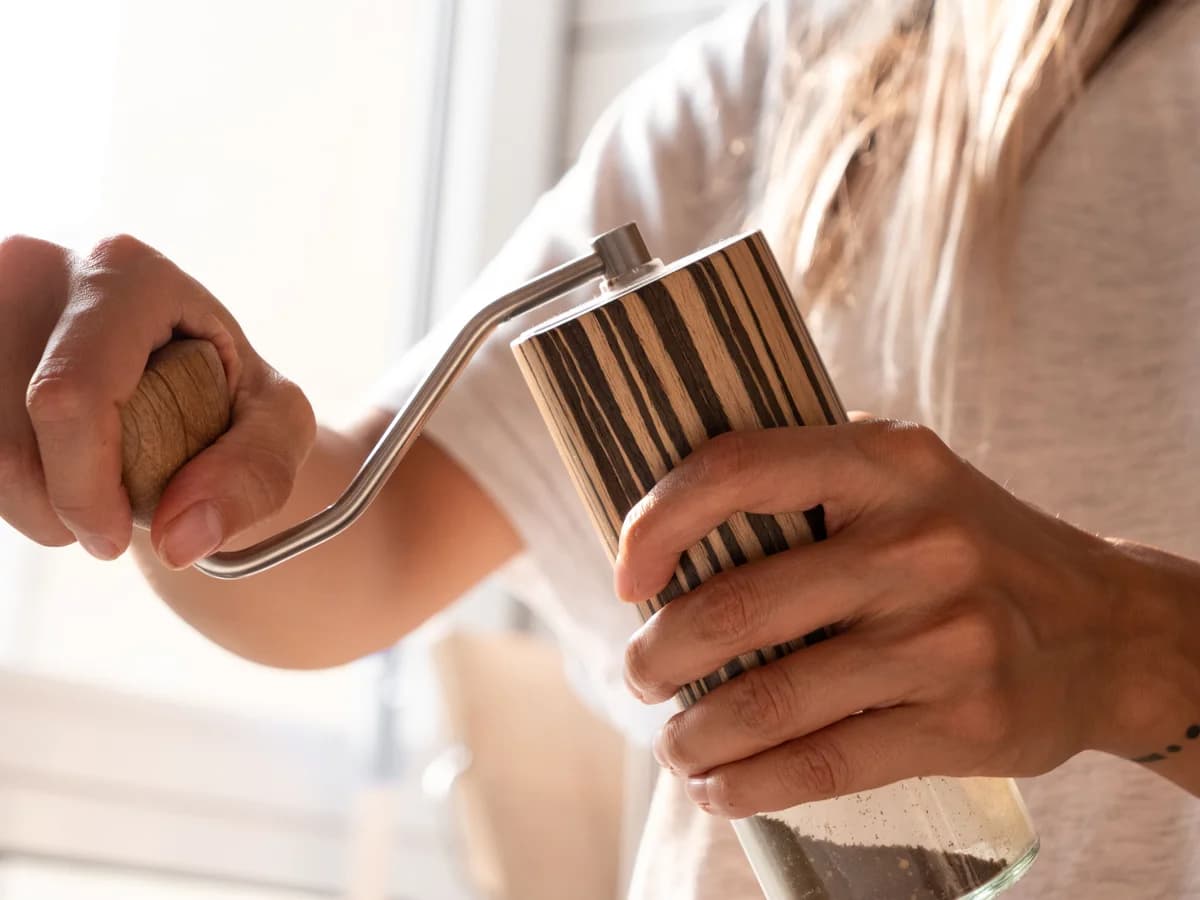
Grinding
Burr grinder
Grinds coffee beans between two abrasive burrs to produce a consistent particle size, which affects extraction more than any other single variable.
- Type
- Grinder
- What it is for
- Grinding
- Who needs one
- Essential
- Materials
- Steel burrs, Ceramic burrs, Aluminium or steel body
- Needs attention
- Brush as grounds build up and as the maker directs (one maker suggests a routine clean every four to six weeks); burr replacement is quoted by weight ground and varies widely by burr and roast.
- Brewing methods
- 9 methods use it
Safety
Unplug before reaching inside. Burr edges are sharp.
Work out whether it is for you
Grinder or brewer: which to upgrade first?
CoffeeHQ explanatory model — not a measurement
What grinds your coffee now?
Nothing: I buy it ground — The grinder comes first, whatever you brew with. Fresh, adjustable grinding changes more than any brewer can.
A blade grinder — A burr grinder is the upgrade. A blade cannot produce an even grind, and no brewer compensates for that.
A burr grinder
Do you make, or want to make, espresso with a standard basket?
Yes, and my grinder cannot go fine enough or adjust in small steps — The grinder is still the limit. Espresso needs fine grinding with very small adjustments, and many filter grinders cannot do it.
Yes, and it can — Then the machine or the accessories are the reasonable next step.
No, filter and immersion only — A different brewer will now change the style of cup. Choose it for the kind of coffee you want, not as an upgrade in quality.
Basis: Reasoned from the widely held view that grind evenness and adjustability limit every brewing method downstream of them. Limits: It ignores water, technique and the coffee itself, each of which can matter more than either purchase.
What it is
If one purchase changes home coffee more than any other, it is this one. A burr grinder sets a gap and reduces every bean to fragments that fit through it, so the coffee that reaches the water is close to one size rather than a mixture of dust and gravel. Everything else on this site — ratio, temperature, technique — operates on whatever the grinder produced, which is why grind is described as the variable with the widest reach.
How it works
Two abrasive surfaces, either a cone in a ring or two facing discs, are held a set distance apart. Beans are drawn into the narrowing gap and fractured repeatedly until the pieces are small enough to escape. Adjusting the gap adjusts the grind. Motor speed, burr sharpness, alignment and how the coffee is fed all affect how tight the resulting spread of sizes is.
Why people use one
Because uneven coffee extracts unevenly, which is the usual explanation for a cup that tastes bitter and sour at once.
Where it fits
Conical and flat burrs compared
CoffeeHQ explanatory model — not a measurement
| Aspect | Conical burrs | Flat burrs |
|---|---|---|
| Shape | A cone turning inside a ring. Coffee falls downward through the gap. | Two facing discs. Coffee is thrown outward between them. |
| Where you usually find them | Hand grinders and many home electric grinders. | Many café grinders and larger home grinders. |
| Motor and speed | Work at low speeds and with little torque, which is why hand grinders use them. | Generally need a stronger motor and run faster. |
| Sensitivity to alignment | More tolerant of small misalignment. | Both discs must be parallel; misalignment shows in the grind. |
| What is said about the cup | Often described as giving more body and a blended flavour. | Often described as giving more clarity and separation. |
Basis: The mechanical rows describe how the two geometries work. The last row reports what is commonly said, not a measured result. Limits: Burr size, the cut of the teeth, alignment and the rest of the grinder matter at least as much as the shape. Two grinders with the same burr shape can taste further apart than a conical and a flat one.
What this actually changes
Separated by what it affects, because “improves your coffee” is not something you can act on. Where the evidence is thin or contested, it says so.
Taste
Real differenceReasoned, not measuredGrind size sets how fast coffee gives up its soluble material, and grind uniformity sets whether it all does so at the same rate. Both are decisive.
Consistency
Real differenceReasoned, not measuredA repeatable setting makes every other variable diagnosable. Without one, nothing else can be held constant.
Workflow
Modest differenceReasoned, not measuredGrind-by-weight and grind-by-time change how much attention dosing takes; retention decides whether what you set is what you get.
Who it is for
Worth having if
- Anyone buying whole beans
- Anyone making espresso, where fine adjustment is the whole of dialling in
Probably skip it if
- Anyone committed to pre-ground coffee and a pressurised basket, for whom a grinder changes nothing until the rest of the setup changes too
Choosing one
What actually differs between them. No products, no rankings.
- Espresso capability
- Espresso needs both a fine grind and fine adjustment near that end. Many good filter grinders reach fine and cannot adjust usefully within it, which is what makes dialling in impossible rather than difficult.
- Stepped or stepless adjustment
- Stepped adjustment is repeatable and easy to return to. Stepless is infinitely fine and easy to lose. Espresso benefits from fine steps; filter rarely needs them.
- Retention
- How much coffee stays inside between doses. High retention means stale carryover and an unreliable dose, and matters most if you single-dose or change coffees often.
- Hopper or single dose
- A hopper is convenient and keeps beans exposed to air. Single dosing keeps coffee sealed and adds a step. Neither is better in the abstract.
- Grind by time or by weight
- Timed grinding is a proxy — the same seconds give a different mass as beans age, roast and grind setting change. Weight-based grinding measures the thing you actually care about, at a price.
Common mistakes
Adjusting grind and dose in the same shot
Two variables moved, so the result explains nothing.
Instead: Change one thing at a time and note the setting.
Adjusting an electric grinder while the burrs are stationary
On many grinders this jams the burrs with trapped coffee.
Instead: Follow the manufacturer's instructions; many require adjustment while running.
Assuming a number on a dial means the same thing across coffees
A setting that worked for one bag runs fast or slow with the next.
Instead: Expect to re-dial for each new coffee, and note the setting per coffee.
Cleaning and care
Brush regularly, and use a grinder-cleaning product for oil build-up according to its instructions. Do not wash steel burrs. Unplug before any burr access.
What you could use instead
No motor to pay for, at the cost of effort. The usual argument is that more of the price goes into the burrs; no comparative test was read.
Grinding at the shop
Free, and the coffee begins staling from that moment.
How to use it
Step-by-step techniques this equipment is part of.
- Adjusting grind sizeMove the grind in the right direction by a useful amount, and know what to expect from the change.
- Dialling in espressoFind the grind setting and recipe that make a particular coffee taste as intended, and be able to return to it.
- Dialling in filter coffeeFind the grind and ratio that suit a particular coffee in a particular brewer, using brew time as a reading and never as a target.
- Purging a grinderClear coffee left inside the grinder so the next dose is the coffee and the setting you intended.
- Single dosing a grinderGrind exactly the beans you weighed for this brew, with as little left inside the grinder as possible.
- Cleaning a grinderRemove built-up coffee oils and retained grounds without damaging the burrs.
- Cupping coffeeTaste several coffees against each other under conditions identical enough that the only difference is the coffee.
When it goes wrong
Brewing methods that use this
Where this equipment is part of the method rather than optional.
Coffee makers that need one
Devices whose profile records this equipment as required. Each links to setup, ratio, cleaning and running cost.
The science behind it
- Fines and boulders
The two extremes of a grinder's output — dust-like fines and oversized boulders — that both cause problems in the same cup.
- Grind consistency (particle distribution)
How uniform the ground-coffee particle sizes are, not just their average.
- Retention (grinder)
Leftover grounds from a previous grind still sitting inside the grinder, mixing into the next one.
- Burrs versus blades
Two different grinding mechanisms — burrs crush coffee to a controllable, consistent size; blades chop it unevenly.
Often used alongside
Other equipment this one is used with, or that the same brewing methods call for.
Drinks it appears in
Drinks that name this equipment, or that are brewed by a method requiring it.
Compare the options
Side-by-side comparisons this category appears in.