Coffee maker
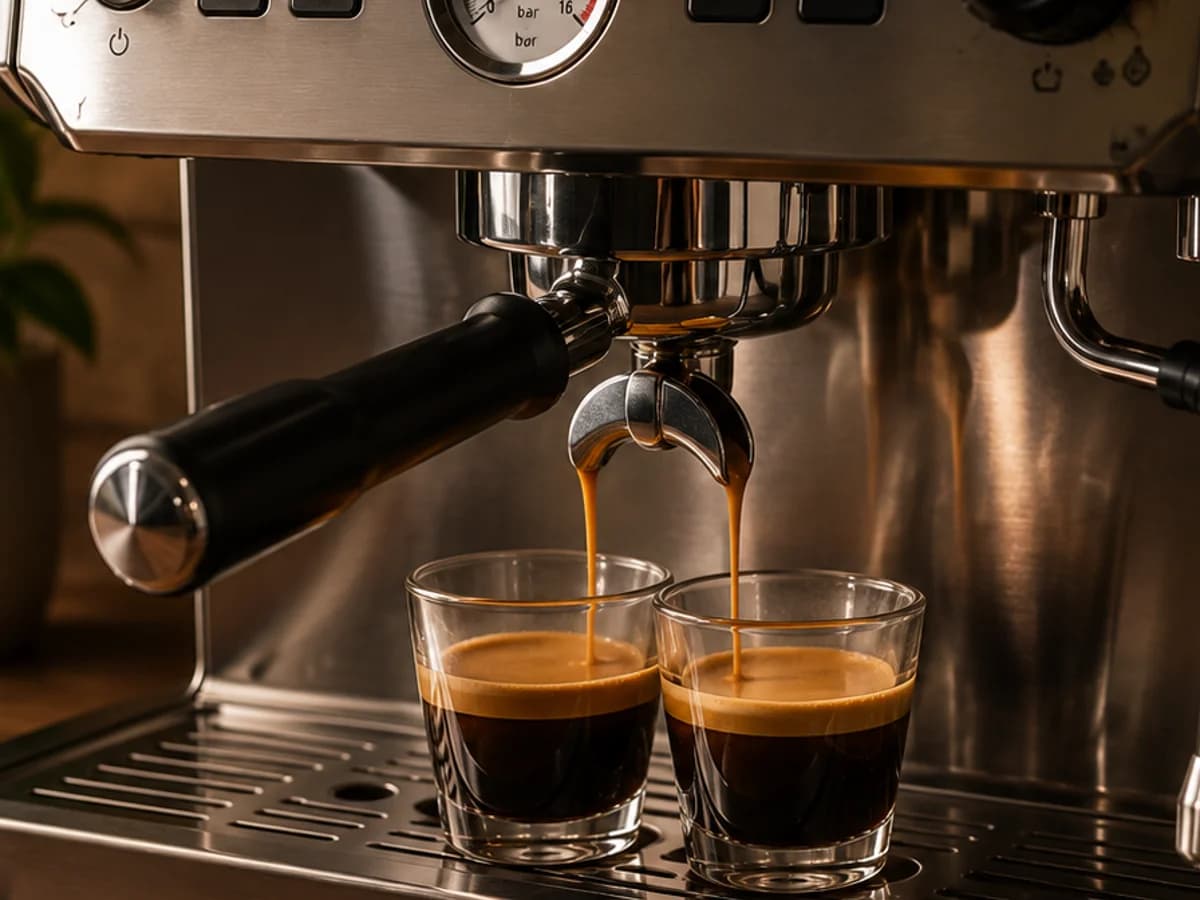
Semi-automatic espresso machine
A pump-driven espresso machine where the user starts and stops the shot manually but the pump generates consistent pressure.
How it works
An electric pump generates consistent brewing pressure; the user controls dose, grind, tamp and when to start/stop the shot, giving a balance of consistency and manual control.
Who it suits
- home baristas who want to learn proper technique with consistent pump pressure
- households wanting genuine espresso control without a lever's physical effort
Who it may not suit
- users who want zero-effort, one-touch drinks
- Starting dose
- 18g
- Dose-to-yield ratio
- 1:1.5 – 1:2.5 (typically 1:2)
- Grind
- Fine: noticeably finer than table salt, though not a powder.
- Capacity
- 1-2 cups
- Brew time
- 1 min
- Skill level
- advanced
- Noise
- moderate
- Space
- medium
- Cleaning burden
- medium
- Convenience
- medium
- Manual control
- high
Espresso is measured as dose to yield: one part dry coffee to that many parts of liquid beverage in the cup — so 18 g of coffee at 1:2 gives about 36 g of espresso. It is not the coffee-to-water ratio used for filter brewing, which counts the water going in. The espresso ratio calculator works either direction for your own dose.
Descriptive grind labels like this are illustrative starting points, not precise measurements — the same label can mean different particle sizes on different grinders. See the grind size guide for how to dial this in on your own equipment.
Uses the Espresso machine brewing method.
Equipment
Requires a separate grinder.
Advantages
- consistent pump pressure
- full control over dose, grind and shot timing
- genuine milk-steaming capability
Disadvantages
- requires practice to get consistent results
- needs a separate grinder for best results
- higher cleaning burden than pod machines
Taste variables you can control
Derived from CoffeeHQ's own Change the Taste guidance for this machine, not a marketing feature list.
- Grind size
- Dose
- Brew ratio / yield
- Cleaning, prep or maintenance
Change the taste
Tastes sour
(Semi-automatic espresso machine)The shot tastes sour or sharp on a machine with an integrated or adjustable grinder. The reading is the same as on any espresso machine, with a few machine-specific wrinkles.
Try the first step below on its own, taste, then move to the next one only if needed.
| Change | Try | Why | Watch for |
|---|---|---|---|
| FirstGrind size | Decrease: one step finer on the external dial Only if: Adjust the external dial while the grinder runs if the manufacturer requires it; changing the internal burr position shifts the whole external range, so use it only per the manual. | Slows flow and usually increases extraction. | — |
| Dose | Check / reset: recalibrate dose after any grind change | Grind and dose interact — a grind change can shift how much coffee the same scoop or timed dose delivers. | — |
| Brew ratio / yield | Increase: extend the programmed shot volume slightly Only if: Reprogramme the saved volume only once the recipe is stable. | A longer yield for the same dose usually extracts more. | — |
When to reset: Use a single-wall basket and a consistent dose as your baseline before judging any grind change.
Want to know why? Extraction, Contact time
Tastes bitter
(Semi-automatic espresso machine)The shot tastes bitter or harsh, often with a slow flow.
Safety note
Only adjust internal burr settings according to the manufacturer's instructions, and never open the machine or attempt electrical repairs yourself.
Try the first step below on its own, taste, then move to the next one only if needed.
| Change | Try | Why | Watch for |
|---|---|---|---|
| FirstGrind size | Increase: one step coarser on the external dial | Reduces resistance and usually lowers extraction. | — |
| Dose | Check / reset: confirm the correct basket size for your dose | Dual-wall and single-wall baskets behave differently, and an overfilled basket restricts flow regardless of grind. | — |
| Cleaning, prep or maintenance | Check / reset: let retained grounds work through after a grind change | The first drink or two after a grind change may not reflect the new setting yet. | — |
When to reset: Save a new programmed setting only after the recipe has tasted right for a few consistent shots.
Want to know why? Extraction, Water temperature
Cleaning & maintenance
Wipe the steam wand after every use. Flush the group after each session, and backflush with water or detergent only if the manual describes it, at the interval it gives.
Follow the maker's instructions. How often depends on water hardness and use, and some makers advise against owners descaling certain machines.
Replace group head gaskets as they wear.
Consumables: group head gaskets, descaling solution, water filter (if fitted)
Common faults
- shot runs too fast or too slow
- channelling
- weak crema
Cost
Purchase cost band: mid rangeSpans a wide range from entry-level to premium; positioned here at the common mid-range entry point for genuine espresso control.
No pods — ongoing cost is beans, water, and periodic descaling supplies.
Suitable roast levels
What these machines can actually do
This is a category, not a product, and machines within it genuinely differ. Where a capability varies, the answer is not on this page — it is on your machine, and each entry says how to find it.
Check these on your own machine
Three-way solenoid valve
Listen at the end of a shot for a brief hiss into the drip tray, and look at the puck: firm and dry means a three-way valve, wet and loose means none. The manual mentioning backflushing is the other reliable sign.
This is the single most useful thing to establish about a semi-automatic machine. It decides whether your puck comes out dry or soupy, and whether backflushing does anything at all.
PID temperature control
A temperature readout, or a stated set point in the manual. A machine with a simple thermostat has neither.
Common above the entry level and rare below it.
Adjustable brew temperature
A settable brew temperature in the manual or on the display. A machine with a fixed thermostat has none.
Pressure gauge
A gauge on the front face. Check what it is measuring: some entry-level machines label a boiler-pressure gauge as if it showed brew pressure, and the two behave differently.
Pre-infusion
Watch the first seconds of a shot: a machine with pre-infusion wets the puck without the pressure gauge climbing immediately.
Flow control
A paddle or an adjustable knob on the group head itself, rather than a switch on the front panel.
Shot timer
A seconds display that starts when the shot does. A clock showing the time of day is not one.
Volumetric dosing
Programmable cup buttons that stop the shot themselves. If you have to stop it, the machine is not volumetric.
Heat exchanger
The manual will describe a cooling flush before brewing. If it does, you have a heat exchanger.
Dual boiler
The manual will state two boilers, and the machine will steam and brew at the same time without waiting.
Thermoblock or thermocoil
A machine ready to brew within a minute or so of switching on almost certainly heats water on demand rather than storing it.
Brew and steam at once
Try it: start a shot and open the steam valve. A single-boiler machine will lose brew pressure or refuse; a heat exchanger or dual boiler will not.
Pannarello or assisted wand
A plastic collar around the metal wand, usually with a small hole in the side. Pulling it off — if the manual allows — exposes the bare tip underneath.
Common on entry-level machines, and usually removable — taking the sleeve off converts it into a conventional wand.
Ships with a pressurised basket
Take the basket out and look at the underside. Many fine holes across the whole surface means single-wall; one small hole, often in a removable plastic insert, means pressurised.
Almost universal at the entry level. Check before following any dial-in advice, because with one fitted very little of that advice applies.
Plumbed water inlet
A braided hose connection at the back, and no removable tank.
58 mm portafilter
Measure across the inside of the portafilter rim. 58 mm is the commercial standard; domestic machines are often 51 mm or 54 mm, and buying a 58 mm accessory for one of those is the commonest wasted purchase in home espresso.
Workflow and fittings
- Ships with a pressurised basketVaries — check yours
It is the single most consequential thing to know about an entry-level machine, and most owners do not know it. With one fitted, grind changes, distribution and tamping barely affect the shot — so espresso advice appears not to work.
- Takes a standard single-wall basketUsually
This is the upgrade path. A machine that accepts a single-wall basket can make real espresso once there is a grinder to match; one that cannot is capped wherever it is.
- 58 mm portafilterVaries — check yours
Accessories are sized to the group. A 58 mm machine can use the widest range of tampers, funnels, distribution tools and baskets; smaller domestic sizes such as 51 mm and 54 mm have narrower choice.
Water and pressure release
- Three-way solenoid valveVaries — check yours
It decides two things people worry about for no reason. It is what leaves a firm, dry puck that knocks out cleanly — and it is why a machine without one leaves a wet, soupy puck that is not a fault. It is also what makes backflushing possible: without a three-way valve there is nowhere for the water to go, and the procedure does nothing.
What it does not mean: A wet puck is not evidence of a bad extraction. On a machine with no three-way valve it is the expected result, and no amount of grind or dose adjustment will change it.
- Removable water tankUsually
You choose the water, which is the cheapest way to control scale and taste. It also needs emptying and cleaning: a tank left standing grows things, and a machine left full over a holiday is worse than one left empty.
- Plumbed water inletUncommon
No refilling, and water treatment moves from a jug to an inline cartridge sized against your water hardness. Most manufacturers make some form of treatment a condition of warranty on plumbed machines.
Heat and temperature
- PID temperature controlVaries — check yours
Brew temperature affects extraction, and a machine that drifts several degrees between shots makes every other adjustment harder to read. A PID mostly removes that variable.
What it does not mean: A PID does not guarantee a stable temperature at the coffee. It stabilises what it measures, which on some machines is the boiler rather than the group.
- Adjustable brew temperatureUncommon
Lighter roasts are often brewed hotter and darker roasts cooler. It is a real lever and a fine one — worth reaching for after grind and ratio, not before.
- Single boilerUsually
You cannot brew and steam at the same time, and the machine needs a minute or two to move between the two temperatures. That shapes the whole workflow: pull the shot, switch to steam, wait, steam the milk.
- Heat exchangerUncommon
Brewing and steaming are available simultaneously without two boilers. The trade-off is that brew water sitting in the exchanger between shots gets hot, which is why heat-exchanger machines are usually flushed briefly before pulling.
- Dual boilerUncommon
Brew and steam at once, with brew temperature independent of steam pressure. It removes a workflow constraint rather than improving the coffee by itself.
What it does not mean: A dual boiler does not make better espresso than a well-managed single boiler. It removes waiting and makes temperature easier to control; the coffee, the grinder and the puck still decide how the shot tastes.
- Thermoblock or thermocoilVaries — check yours
Very fast warm-up, small and cheap. Temperature is less stable across a shot than a boiler's, and steam capacity is usually limited, which is what makes milk texturing harder on these machines.
Brewing and pressure
- Pump-driven brewingAlways
A pump holds pressure steady without effort, which is what makes shot-to-shot consistency achievable. It also means the pressure is a property of the machine rather than of your arm.
- Pressure gaugeVaries — check yours
It turns an invisible variable into something you can watch, which makes a choked shot or a badly channelling puck obvious as it happens rather than afterwards.
What it does not mean: A needle sitting in a green zone does not mean the shot is good. It means the machine is producing pressure, which says nothing about whether the water went evenly through the coffee.
- Pre-infusionVaries — check yours
It lets the puck settle and swell before being pushed hard, which reduces channelling on a bed that was not perfectly prepared. Implementations differ enormously — some are a timed low-pressure phase, some are simply a line-pressure fill.
- Flow controlUncommon
It gives a second lever over extraction alongside grind, and it lets a shot be rescued mid-pull. It is an enthusiast capability: useful once grind, dose and distribution are already consistent, and a distraction before that.
What it does not mean: Flow control does not compensate for an unevenly prepared puck. It changes how water arrives, not where it goes once it is in the bed.
- Shot timerVaries — check yours
Shot time is the reading that tells you whether a grind change landed. A built-in timer removes one thing to remember, though a phone does the same job.
- Volumetric dosingUncommon
Repeatable without attention, which matters in a café. At home it measures volume rather than the mass in the cup, so it drifts as the coffee ages and the puck resists differently.
What it does not mean: A programmed volume is not the same as a weighed yield. If you are dialling in by ratio, weigh the cup.
Milk
- Brew and steam at onceUncommon
It is a workflow difference rather than a quality one, and it is the main practical reason people move from a single boiler to a heat exchanger or dual boiler. It matters most when making several milk drinks in a row.
- Conventional steam wandUsually
The only arrangement that lets you control how much air goes in and when it stops, which is what microfoam and latte art need. It is also the one that takes practice.
- Pannarello or assisted wandVaries — check yours
It makes foam almost regardless of technique, which is exactly why it cannot make microfoam: the air is introduced by the sleeve rather than by you, and the foam is airy and coarse. Many machines let you remove the sleeve, which converts it into a conventional wand.
Skills for this machine
The individual techniques this device asks of you, each with its own adjustments and failure modes.
- Steaming milkProduce hot milk with a fine, integrated foam that pours as one liquid rather than as foam sitting on milk.
- Making microfoamReduce the air in steamed milk to bubbles too small to see, so the foam and the liquid behave as one substance.
- Judging milk temperatureStop steaming at a temperature that keeps the milk sweet and the texture fine, without needing to read a thermometer mid-drink.
- Steaming plant milkTexture a plant milk without splitting it, and know when the carton rather than the technique is the problem.
- Purging and wiping the steam wandClear milk from the wand before it dries, so the next drink is not made through yesterday's residue.
- Pouring latte artPlace textured milk on the surface of an espresso in a controlled pattern, by managing height, flow and cup angle.
- Distributing espresso grounds (WDT)Leave the coffee bed uniformly dense throughout, so water meets the same resistance everywhere and does not carve a channel.
- Tamping espressoCompress the coffee bed into a level, uniformly dense puck, without introducing a slope or a crack.
- Dialling in espressoFind the grind setting and recipe that make a particular coffee taste as intended, and be able to return to it.
- Diagnosing a shot with a bottomless portafilterRead what the underside of the basket is doing during extraction, and match what you see to the preparation fault that caused it.
- Adjusting grind sizeMove the grind in the right direction by a useful amount, and know what to expect from the change.
- Purging a grinderClear coffee left inside the grinder so the next dose is the coffee and the setting you intended.
- Single dosing a grinderGrind exactly the beans you weighed for this brew, with as little left inside the grinder as possible.
- Backflushing an espresso machineFlush coffee residue out of the group head and three-way valve using a blind basket, with or without detergent.
- Descaling a machineDissolve mineral scale out of the boiler and water path, when and how the maker of the machine directs.
- Resting roasted coffeeLet a fresh roast settle to the point where it brews predictably, without waiting until it has gone flat.
- Measuring extraction yieldTurn a TDS reading into an extraction percentage, and know what that number can and cannot tell you.
Related guides
Not sure if this is right for you? Try the coffee-maker selector.