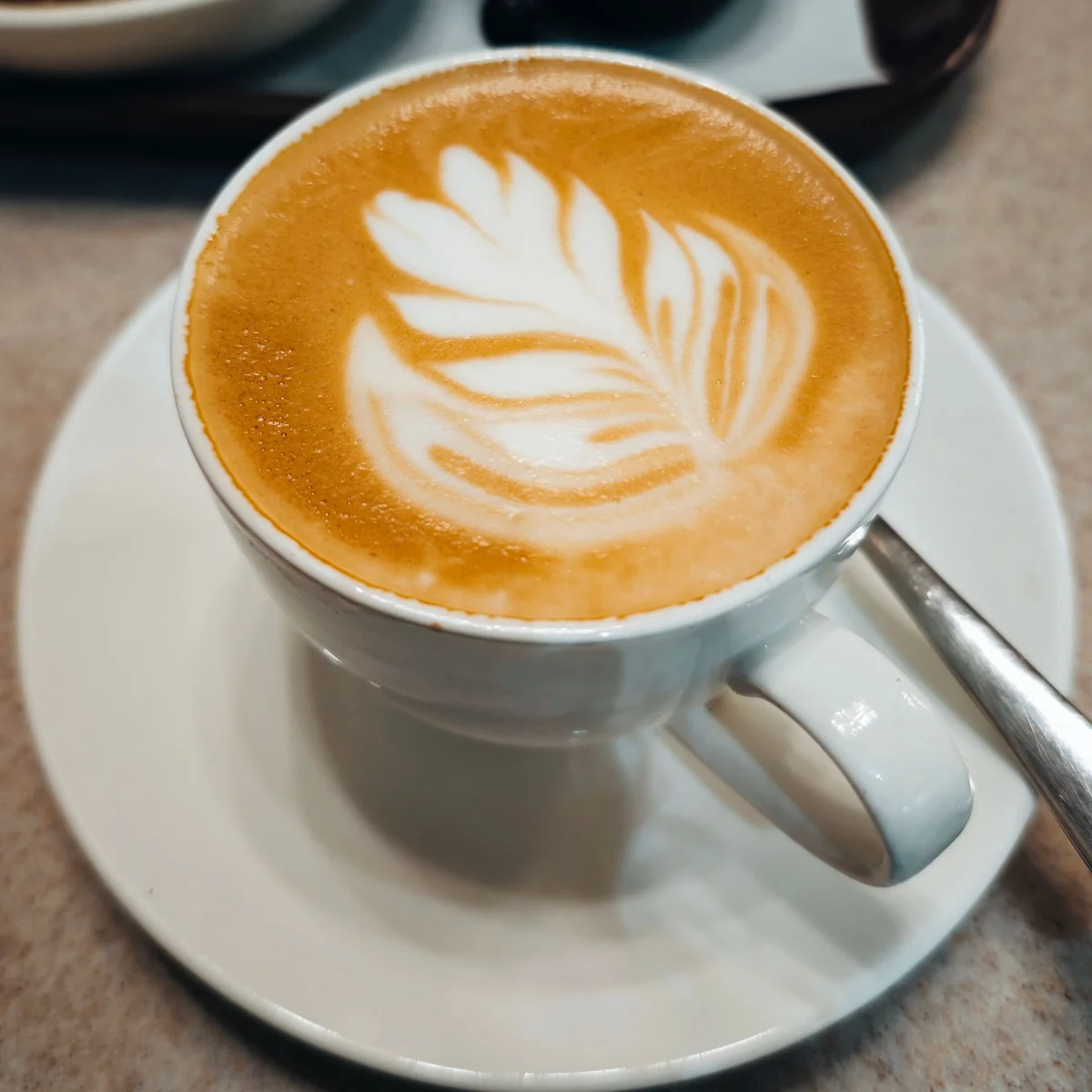
Latte
A double espresso shot with a larger volume of steamed milk and a thin layer of foam, giving a milder, milkier drink than a cappuccino or flat white.
- Coffee dose
- 18g
- Yield
- 240ml
- Milk
- 200ml
- Intensity
- medium
- Preparation time
- 3 min
- Skill level
- intermediate
In short
A latte is a shot or two of espresso with a large amount of steamed milk and a thin layer of fine foam on top. It is the mildest of the standard espresso drinks, because the milk outweighs the coffee several times over.
That dilution is what makes it approachable and also what makes it easy to get wrong. With so much milk in the cup, the milk's temperature and texture decide most of what you taste, and a latte with a harsh or weak shot underneath simply tastes of hot milk.
A drink that is mostly milk
Typical range
- Espresso — a single or double shot, roughly 25–45 ml, about 10%–18% of the cup
- Steamed milk — roughly 180–280 ml, about 76%–86% of the cup
- Foam layer — up to about a centimetre, about 3%–7% of the cup
Why a good latte tastes sweet without sugar
CoffeeHQ explanation
Milk tastes noticeably sweeter warm than cold, and steaming it to the right temperature brings that out. Taken too far, the same milk tastes flat and slightly cooked, which is why an overheated latte seems to need sugar and a well-steamed one usually does not.
Texture does the rest. Very fine foam carried through the milk gives the drink a soft, rounded feel that reads as richness. Milk that has only been heated, with no air folded in, makes a thin drink that tastes weaker than it is.
A reliable home method
CoffeeHQ explanation
- Choose the cup, then the shot. For a cup up to about 250 ml a single shot gives a mild latte and a double a stronger one. Above that, a double is usually needed for the coffee to register at all.
- Pull the espresso into the cup. Brew straight into the serving cup so the crema is intact when the milk arrives. This is what gives the surface its colour and makes a pattern possible.
- Steam with a short burst of air. Let air in for about three to four seconds, then lower the tip and keep the milk spinning until the jug is hot to the touch. You want slightly more foam than for a flat white and far less than for a cappuccino.
- Pour high, then low. Begin from a few centimetres above the cup so the milk dives under the crema, then bring the jug down close to the surface to let the foam flow out for the top layer.
What goes wrong, and what to change first
Tendency, not a guarantee
- It tastes watery and thin
Usually because: The milk was heated but not textured, or a single shot is lost in too large a cup.
Change first: Let a little more air in at the start of steaming. If the texture is already good, move to a double shot.
- It tastes flat, cooked or slightly eggy
Usually because: The milk was overheated. Past the point where the jug is uncomfortable to hold, sweetness falls away quickly.
Change first: Stop steaming earlier. Use a thermometer for a few drinks until your hand learns the stopping point.
- A bitter edge comes through all that milk
Usually because: The espresso is over-extracted. Milk softens bitterness but does not remove it, and a long, slow shot shows through.
Change first: Fix the shot on its own first: grind a little coarser, or stop it a few grams earlier.
- The pattern comes out as a white blob
Usually because: The foam is too thick to flow, or the pour started too close to the surface and too late in the cup.
Change first: Add less air, and begin the pattern when the cup is about half full rather than nearly full.
Versions you will meet
Tendency, not a guarantee
- Iced latte
- Espresso poured over ice and cold milk, with no steaming. It tastes weaker than the hot version for the same shot because cold dulls sweetness and the ice dilutes it as it melts.
- Flavoured latte
- A latte with a syrup such as vanilla or caramel added to the cup before the milk. The syrup adds sweetness as well as flavour, so the coffee underneath recedes further.
- Latte macchiato
- The order reversed: espresso poured through a glass of steamed milk and foam so it settles in a visible layer. It is milkier and usually served taller than a caffè latte.
- Plant-milk latte
- Made the same way, but the result depends heavily on the product. Versions formulated for baristas are built to foam and to resist splitting in hot, acidic coffee.
A note on the word
Widely documented
Latte is simply the Italian word for milk, and caffè latte means coffee with milk. In Italy it is traditionally a breakfast drink made at home, often with coffee from a moka pot, and asking a bar for a latte may well get you a glass of milk.
The espresso-bar latte, with steamed milk and poured patterns, is largely a development of cafés outside Italy during the late twentieth century. It is the version this page describes.
What to do next
- Steaming milk — milk is most of this drink, so this is where most of the improvement is.
- Milk drink builder — works out how much milk to steam for your cup, so you stop over-filling the jug and wasting it.
- Cappuccino vs. latte — shows what changes when the same ingredients are combined with more foam and less milk.
- Judging milk temperature — overheating is the most common reason a home latte tastes flat.
- Become a barista — A structured programme from dose and grind through milk, drinks and maintenance.
Caffeine estimate
Approximately 108-198mg (the whole of an 18 g dose of arabica).
Inferred, not independently verified — CoffeeHQ's caffeine estimator's range for this recipe's dose. It is a model built from published measurements of other coffees, not a measurement of this drink. Milk adds none.
Brewing method
Made using Espresso machine.
How it tastes
Mild and milky, with a thin layer of foam and the largest milk volume of the standard espresso-milk drinks, so the coffee flavour is the most diluted of the group while still being clearly present.
Size and ratio vary considerably by market — a UK or US café latte is often noticeably larger than a traditional Italian caffè latte, which is closer in size to a cappuccino.
Recipe card
- Pull a double espresso shot.
- Steam a larger volume of milk to a thin foam.
- Pour milk over the espresso.
Equipment
Related drinks
- milk based version of Espresso
Compare
Build this drink
Tools for working out the quantities this drink needs.
How to make it well
Step-by-step techniques this drink depends on, each with what to change when it does not work.
- Steaming milkProduce hot milk with a fine, integrated foam that pours as one liquid rather than as foam sitting on milk.
- Making microfoamReduce the air in steamed milk to bubbles too small to see, so the foam and the liquid behave as one substance.
- Judging milk temperatureStop steaming at a temperature that keeps the milk sweet and the texture fine, without needing to read a thermometer mid-drink.
- Steaming plant milkTexture a plant milk without splitting it, and know when the carton rather than the technique is the problem.
- Frothing milk without a steam wandGet a usable milk foam using an electric frother, a whisk, a French press or a jar, and know what each can and cannot produce.
- Purging and wiping the steam wandClear milk from the wand before it dries, so the next drink is not made through yesterday's residue.
- Pouring latte artPlace textured milk on the surface of an espresso in a controlled pattern, by managing height, flow and cup angle.
Milk that suits it
How each behaves when steamed — foaming, stability and splitting risk. No health comparisons.