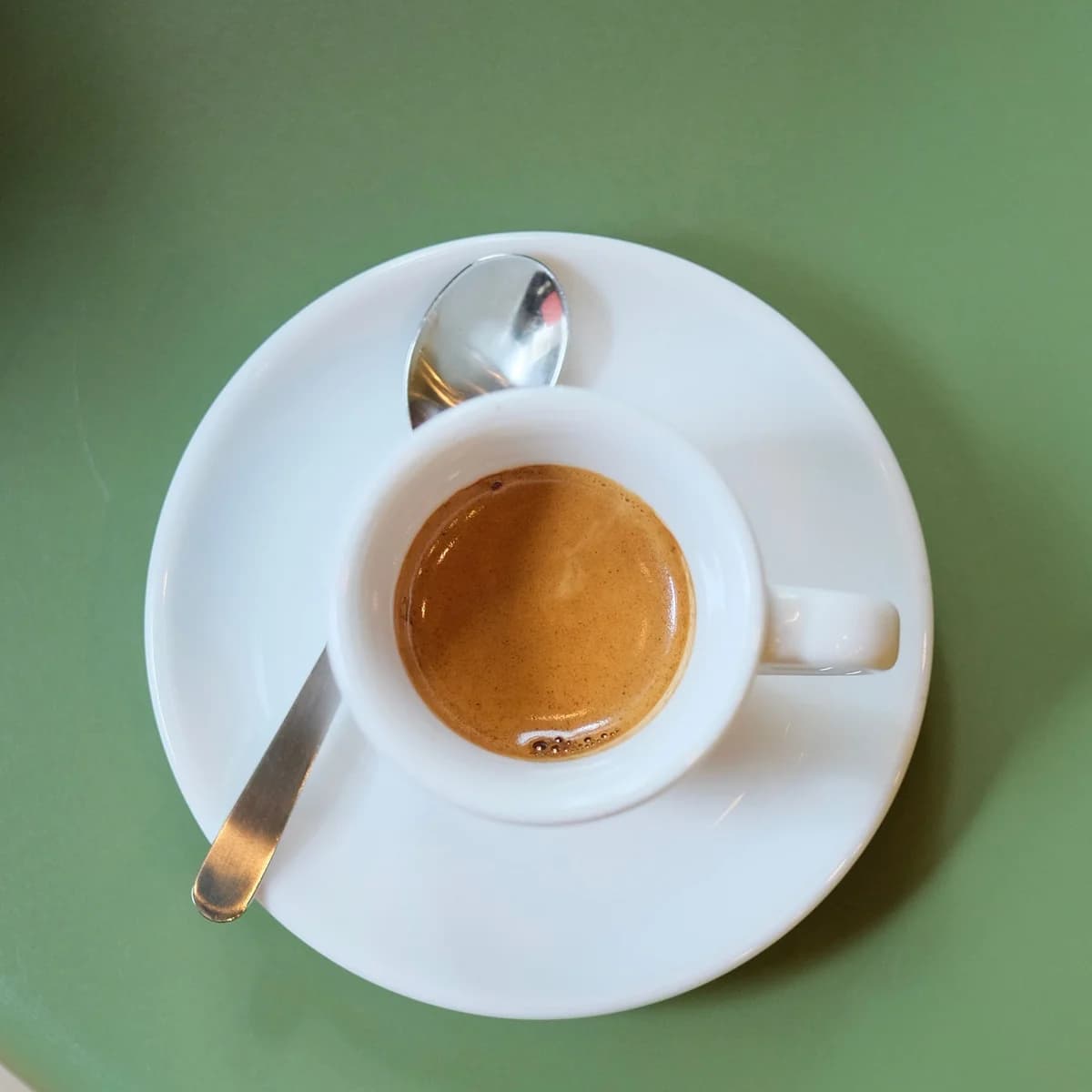
Espresso
A small, concentrated shot of coffee produced by forcing hot water through finely-ground, tamped coffee under pressure. The base for most espresso-based milk drinks.
- Coffee dose
- 18g
- Yield
- 36ml
- Intensity
- very strong
- Preparation time
- 1 min
- Skill level
- advanced
In short
Espresso is coffee brewed by pushing hot water through a compact bed of finely ground coffee under pressure, so that a small amount of water dissolves a lot of coffee in well under a minute. The pressure is not there for its own sake. It is what lets water pass through grounds fine enough to give up their flavour that quickly.
The one idea worth holding on to is that espresso is defined by concentration, not by a bean, a roast or a machine brand. A typical shot carries several times as much dissolved coffee per sip as a mug of filter coffee, and nearly everything distinctive about it follows from that: the syrupy body, the intensity, and the way small mistakes become obvious.
The numbers a shot is described in
Typical range
Baristas describe a shot by weight, because crema makes volume unreliable. Three numbers do most of the work: how much dry coffee went in, how much liquid came out, and how long it took.
| Variable | Typical range | What moving it does |
|---|---|---|
| Dose (dry coffee) | About 7–10 g for a single, 14–20 g for a double | Set by the basket, not by taste. Use the amount your basket is made for and leave it alone while you adjust everything else. |
| Brew ratio (dose to yield) | Roughly 1:1.5 to 1:2.5 | Less liquid per gram of coffee is heavier and more intense; more liquid is lighter-bodied and usually more fully extracted. |
| Time | Often 25–35 seconds | A consequence of grind, not a target to hit for its own sake. Use it to notice that something changed. |
| Water temperature | About 90–96 °C | Lighter roasts are usually brewed towards the top of the range, darker roasts towards the bottom. |
| Pressure | Around 9 bar at the pump | A long-standing convention. Many good shots are pulled lower, and pressure is the last variable worth touching. |
These are the ranges common in specialty cafés, not a standard a shot passes or fails. A traditional Italian single is smaller and often shorter than this; a modern light-roast shot may run longer and further.
Ristretto, espresso, lungo: one drink at three lengths
CoffeeHQ explanation
The same dose can be stopped early or run long. Stopped early, at around one to one-and-a-half times the dose, it is a ristretto: thicker and more intense, with less of the coffee dissolved into less water. Run well past two-and-a-half times the dose it becomes a lungo, which is thinner and, because more has been drawn from the same grounds, usually more bitter.
Where exactly one becomes the other is a matter of local habit rather than definition, and two cafés will draw the lines differently. What does not vary is the direction: shorter is heavier and brighter, longer is lighter and more bitter. That is a more useful thing to know than any boundary.
What crema does and does not tell you
CoffeeHQ explanation
Crema is a foam of carbon dioxide and emulsified coffee oils, formed because gas dissolved under pressure comes out of solution as the liquid leaves the basket. Freshly roasted coffee holds more gas and makes more crema; so do darker roasts and blends containing robusta.
That makes crema a weak guide to freshness and no guide to quality. More gas makes more crema, and fresh coffee has more gas; but so do dark roasts and robusta, and a review of espresso foam adds the bicarbonate in the brewing water as a further source of gas. A thick, dark crema can sit on a harsh shot, and a pale, thin one can sit on a sweet one. A shot with almost no crema from coffee that is only a week or two off roast is worth investigating; a shot with plenty of crema has told you only that the coffee was gassy.
Pulling a shot you can repeat
CoffeeHQ explanation
This assumes a machine with an ordinary, unpressurised basket and a grinder that can be adjusted finely. With a pressurised basket the grind advice below does not apply, because the basket rather than the coffee is creating the resistance.
- Weigh the dose. Grind the amount your basket is designed for into the portafilter and weigh it. A consistent dose is what makes every later adjustment mean something.
- Level, then tamp once. Break up clumps and spread the grounds evenly before pressing them flat. Evenness matters far more than how hard you press; an uneven bed gives water a shortcut.
- Brew onto a scale. Start the shot straight after locking in, and stop it when the cup reaches about twice the weight of the dose. Note how many seconds that took.
- Taste before you change anything. Stir the shot and taste it. Decide whether it is sour and thin, bitter and drying, or balanced, and change one thing in response.
If the shot reaches its target weight much faster than about 25 seconds, grind finer; much slower than about 35, grind coarser. Then taste again. Time gets you into the right neighbourhood and taste makes the final decision.
When the shot tastes wrong
Tendency, not a guarantee
Change one variable per shot. Two changes at once will sometimes fix the problem and will never tell you which change did it.
- Sour, sharp and thin, finishing quickly
Usually because: Too little has been dissolved. The water passed through too fast or too little of it was used, so the acids, which dissolve readily, are left without much to balance them.
Change first: Grind finer so the same yield takes longer. If it is already slow and still sour, let the shot run a little further instead.
- Bitter, harsh and drying on the tongue
Usually because: Too much has been dissolved, or it has been dissolved unevenly. Very long contact pulls out the heavy, astringent compounds that arrive last.
Change first: Grind slightly coarser, or stop the shot a few grams earlier. Do not do both at once.
- Sour and bitter in the same mouthful
Usually because: Channelling. Water found a path of least resistance, over-extracting the coffee along it and under-extracting everything else.
Change first: Leave the grind alone and improve how the grounds are distributed and tamped before the next shot.
- Flat and papery, with little aroma or crema
Usually because: The coffee is stale. Espresso magnifies whatever is in the bean, including the loss of aroma that comes with age.
Change first: Check the roast date before touching the grinder. No adjustment restores aroma that has already gone.
Strong is not the same as high in caffeine
CoffeeHQ explanation
Espresso tastes strong because it is concentrated: there is a great deal of dissolved coffee in each sip. But a shot is small. Measured per drink rather than per millilitre, a single espresso usually delivers less caffeine than a large mug of filter coffee, simply because the mug contains so much more liquid.
The caffeine estimate above states the basis it is calculated on. If you want more caffeine the dependable route is a second shot or a larger dose, not a darker roast or a longer pull.
What espresso becomes with water or milk
CoffeeHQ explanation
- Americano — The same shot let down with hot water to roughly the strength of filter coffee, keeping espresso's heavier body and roast character.
- Macchiato — An espresso with a spoonful of milk foam on top: still an espresso in strength, with the first sip softened.
- Cortado — Espresso cut with about its own volume of steamed milk and almost no foam, so the coffee still leads.
- Flat white — A double shot under a small amount of thin, glossy microfoam. Milky in texture, coffee-forward in taste.
What to do next
- Dial in espresso — the full method for arriving at a grind setting for a new bag of coffee, one change at a time.
- Espresso ratio calculator — turns the dose and yield you weighed into a ratio and tells you where it sits between ristretto and lungo.
- Espresso puck preparation — most shots that are sour and bitter at once are a distribution problem, and this is where that is fixed.
- How an espresso machine extracts — explains what pressure, temperature and the basket are each doing, which makes the advice above less arbitrary.
- Become a barista — A structured programme from dose and grind through milk, drinks and maintenance.
Caffeine estimate
Approximately 108-198mg (the whole of an 18 g dose of arabica).
Inferred, not independently verified — CoffeeHQ's caffeine estimator's range for this recipe's dose. It is a model built from published measurements of other coffees, not a measurement of this drink. In the one study that weighed such shots, a longer shot from the same dose held more caffeine than a shorter one.
Brewing method
Made using Espresso machine. Grind: Fine: noticeably finer than table salt, though not a powder.
Descriptive grind labels like this are illustrative starting points, not precise measurements — the same label can mean different particle sizes on different grinders. See the grind size guide for how to dial this in on your own equipment.
How it tastes
Concentrated and syrupy in body, with a reddish-brown crema on top that carries much of the aroma. Balance shifts from sweet to bitter across the shot — the first drops are typically the sweetest, the last the most bitter — which is part of why a shot is meant to be drunk together rather than sipped slowly.
What counts as 'espresso' varies by tradition — a traditional Italian shot is often shorter and more concentrated than the longer, larger shots common at many specialty cafés elsewhere. The dose and yield given here are a practical starting point, not a universal standard.
Recipe card
- Grind 18g of coffee fine, directly into the portafilter basket.
- Distribute and tamp level.
- Lock in the portafilter and start the shot immediately.
- Stop the shot at roughly 36g liquid yield. How long that takes is a reading of the grind, not a target.
Equipment
Troubleshooting
Related drinks
- drink uses brewing method Espresso machine
Preparation traditions
Regional preparation traditions this drink belongs to or comes from, in CoffeeHQ's international preparation atlas.
Build this drink
Tools for working out the quantities this drink needs.
- Espresso dose and yield calculatorWork out the yield to stop a shot at, the dose to start from, or the ratio a shot actually hit.
- Caffeine estimatorGet an honest range for how much caffeine a drink is likely to contain, and understand what makes it uncertain.
- Drink composition comparatorSee what is actually in the cup for two to four café drinks, and which difference between them matters most.
How to make it well
Step-by-step techniques this drink depends on, each with what to change when it does not work.
- Distributing espresso grounds (WDT)Leave the coffee bed uniformly dense throughout, so water meets the same resistance everywhere and does not carve a channel.
- Tamping espressoCompress the coffee bed into a level, uniformly dense puck, without introducing a slope or a crack.
- Dialling in espressoFind the grind setting and recipe that make a particular coffee taste as intended, and be able to return to it.
- Diagnosing a shot with a bottomless portafilterRead what the underside of the basket is doing during extraction, and match what you see to the preparation fault that caused it.
- Adjusting grind sizeMove the grind in the right direction by a useful amount, and know what to expect from the change.
- Purging a grinderClear coffee left inside the grinder so the next dose is the coffee and the setting you intended.
- Single dosing a grinderGrind exactly the beans you weighed for this brew, with as little left inside the grinder as possible.
- Preheating a brewerStop cold equipment taking heat out of the brew before it has finished extracting.
- Backflushing an espresso machineFlush coffee residue out of the group head and three-way valve using a blind basket, with or without detergent.
- Descaling a machineDissolve mineral scale out of the boiler and water path, when and how the maker of the machine directs.
- Tasting coffee deliberatelyNotice what a coffee is actually doing, rather than only whether you like it.
- Resting roasted coffeeLet a fresh roast settle to the point where it brews predictably, without waiting until it has gone flat.
- Measuring extraction yieldTurn a TDS reading into an extraction percentage, and know what that number can and cannot tell you.