Tool
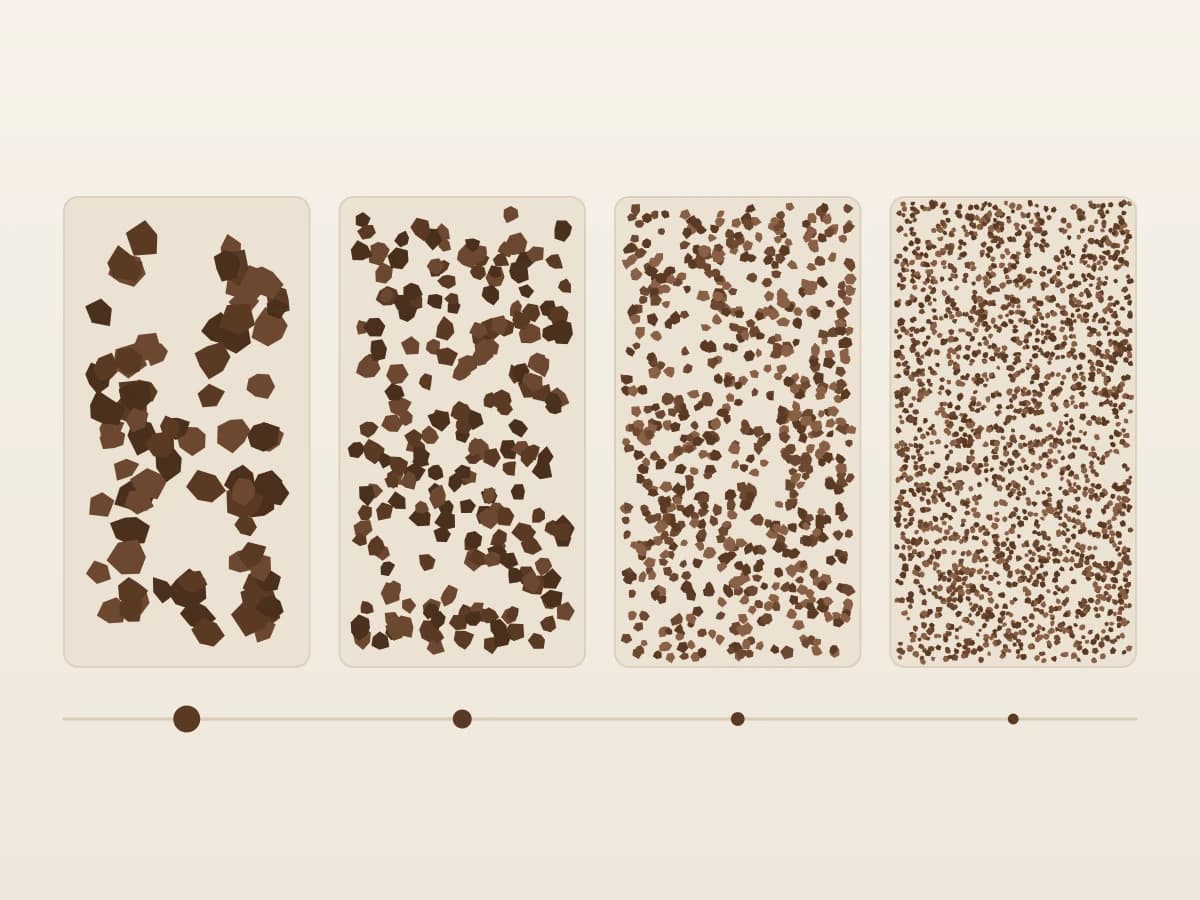
Grind-size guide
Descriptive, method-specific starting points and adjustment direction. Grinder click numbers are not comparable between machines, so this does not pretend otherwise.
Where to start
Fine: noticeably finer than table salt, though not a powder.
On the scale below that is fine. It is a starting point: the right grind for your coffee and your grinder is found by brewing, not by matching a description.
The grind scale, finest to coarsest
CoffeeHQ explanatory model — not a measurement
Extra fine
A soft powder with no grit between the fingers. It stays suspended in the cup.
Used for: Turkish coffee and other unfiltered boiled coffee
FineEspresso machine starts here
Packs into a bed dense enough to hold back water under pressure. Small changes make a large difference.
Used for: Espresso
Medium-fine
Extracts quickly and drains fairly slowly. Suits short brews and small doses.
Used for: Moka pot, AeroPress, small pour-overs
Medium
Lets water pass at a steady rate over a few minutes.
Used for: Pour-over, flat-bottomed drippers, filter machines, phin (guidance ranges a step either side)
Medium-coarse
Drains readily even through thick paper or a deep bed.
Used for: Chemex, larger batches, siphon
Coarse
Extracts slowly, which suits a long steep, and is easy to hold back with a mesh.
Used for: French press, most cold brew
Extra coarse
Extracts very slowly. Meant for contact times of many hours.
Used for: Cold brew recipes with the longest steeps
Basis: Seven named steps in the order every grinder shares, with how each behaves in a brewer. Limits: The steps have no particle sizes or grinder settings, because neither transfers from one grinder to another. Neighbouring steps overlap.
What the brew is telling you
How it flowed
Flow is the most direct evidence about grind. Read it before you read the taste.
An espresso shot reaches its yield well ahead of the usual time and looks pale
Grind finer. Grind slightly finer. Espresso responds to very small steps.
Rule out: Channelling also makes a shot run fast. If the flow spurts or one side runs first, look at puck preparation.
An espresso shot drips, takes far longer than usual, or does not come through
Grind coarser. Grind slightly coarser.
Rule out: An over-filled basket slows a shot in the same way. Check the dose is what you intended.
How it tasted
Taste points at grind only alongside the flow. Each of these has another cause worth ruling out.
Sour, sharp and thin, and the brew was also quick
Grind finer. Grind one step finer.
Rule out: Water that is too cool, or a brewer that was not preheated, gives the same taste at a normal brew time. If the time was normal, look there first.
Bitter, harsh or drying, and the brew was also slow
Grind coarser. Grind one step coarser.
Rule out: A very dark roast or stale coffee tastes bitter at any grind. If a coarser grind only makes it weak and still bitter, the coffee is the cause.
Weak and watery, with nothing actually wrong with the flavour
Not the grind first. Use more coffee for the same water. This is strength, and strength is set by the ratio.
Rule out: Grinding finer to fix a weak cup extracts more and tends to add bitterness without adding much strength.
Bitter and sour in the same cup
Not the grind first. Look at evenness before grind size: an uneven grind or an uneven bed extracts some coffee too much and some too little.
Rule out: Moving the grind either way trades one fault for the other. A blade grinder or a clumping grinder is a common cause.
- Change one thing
- Change the grind by one step and keep the dose, the water, the temperature and the technique exactly as they were. Then taste again before changing anything else.
- What this cannot tell you
- This cannot give you a grinder setting. Numbers and clicks mean different things on every grinder, and the same setting drifts as burrs wear and as the coffee changes. The rung is where to start; the brew tells you where to go.
Once you have a place to start
- You need to move the setting and want to know how far: Adjusting grind size
- The grind is set and the cup is still wrong: Make my coffee better
- The grinder itself is misbehaving: When the grinder is the problem
- You want to know what grind size does to a brew: Grinding and particle size
When the grinder is the problem
The scale above says where to set a grinder. This part is for when the grinder itself seems to be at fault. Find what you noticed, run the check, and change the one thing named before anything else.
Each one follows the same order: what it could be, the quickest check, one thing to change first, what to watch for, what to try if that does not help, and why.
The grind seems too fine or too coarse for the brew
What it could be
- The setting is simply off for this coffee. Likelier when: It is a new bag or a different roast, and the brew now runs steadily faster or slower than the last coffee did.
- It is not the grind: the amount of coffee or water changed. Likelier when: The cup is weak or heavy but the brew ran about as it usually does.
- The setting was copied from somebody else's grinder or from a chart. Likelier when: You have never found the setting for yourself on this grinder.
- The grinder moved: it was cleaned, reassembled or knocked. Likelier when: The same coffee at the same number behaves differently from last week.
Quickest check: Read how the brew ran before how it tasted. Faster than usual points to a coarse grind and slower to a fine one. Then confirm the amount of coffee by weight, because a short dose looks like a coarse grind.
Change one thing first: Move the grind one small step in the direction the flow points, and leave everything else alone.
Then watch for: The flow moving the way you expected. Taste after that: a brew that now runs as usual and tastes good needs nothing more.
If that does not help: If the flow is normal and the taste is still off, the grind was not the cause; take what you noticed to Make my coffee better. If the same number gives a different grind after cleaning, treat the number as new and find the setting again by brewing.
Why: Finer grounds offer more surface and resist water more, so the same brew runs slower and takes more from the coffee. The number on the dial is a position of the burrs in units the maker chose, which is why it does not carry over from another grinder or survive reassembly unchanged. (Reasoned from how the equipment works.)
Espresso still runs fast with the grinder at its finest
What it could be
- Too little coffee in the basket. Likelier when: The spent puck is wet and loose, and there was a lot of room above the coffee.
- The coffee is old, or was ground some time ago. Likelier when: The shot is pale and thin with little crema, and the bag has been open a long while. That stale coffee runs fast is common barista experience.
- Water is finding a path through the puck. Likelier when: The flow spurts or comes from one side, and the puck shows a hole or a crack.
- The grinder was not built for espresso. Likelier when: It is a blade grinder, or a grinder sold for filter coffee, and it has never reached a slow shot with any coffee.
- The grinder can no longer reach as fine as it did. Likelier when: It used to choke a shot at this end of its range and no longer does.
Quickest check: Weigh the dose and confirm it is what the basket is made for. Then pull one shot of a fresh bag at the finest setting. If a fresh, full dose still gushes, the limit is the grinder and not your technique.
Change one thing first: Bring the dose up to what the basket is made for, by weight.
Then watch for: A slower start and a single steady stream. Stop the shot by weight as you normally would.
If that does not help: If a full dose of fresh coffee, evenly prepared, still runs fast, the grinder is the limit. Its manual says whether its range can be reset and how; do not force an adjustment past its stop. A pressurised basket, where the machine came with one, is made for coarser grounds, and the grinder selector covers what an espresso grinder needs.
Why: A puck resists water according to how fine the grounds are, how much coffee there is and whether the bed stays whole. A grinder with too little range at the fine end leaves dose and preparation as the only controls. (Reasoned from how the equipment works.)
A tiny adjustment swings the shot from gushing to choking
What it could be
- This is espresso behaving normally. Likelier when: You moved a full step on a stepped grinder, or made the size of change you would make for filter coffee.
- The steps are too wide for espresso. Likelier when: The shot you want sits between two neighbouring settings whatever you do.
- The first dose after a change is a mix of the old setting and the new. Likelier when: The second shot after an adjustment runs differently from the first.
- Something else is changing with the grind. Likelier when: The dose is not weighed, or the puck is prepared a little differently each time.
- Play in the adjustment. Likelier when: Arriving at the same mark from the fine side and from the coarse side gives different shots.
Quickest check: Make one adjustment, grind and throw away a small amount, then pull two shots without touching anything. Two shots that agree mean the grinder repeats and the step is the difficulty. Two that disagree point at dose and preparation.
Change one thing first: Purge a small amount of coffee after every adjustment, before you judge it.
Then watch for: Shots that follow the adjustment you made, in the direction you made it.
If that does not help: If the step really is too wide, keep the grind and close the gap with a small change of dose by weight, one way only. If arriving from different sides matters, always approach the mark from the same side. Stepless adjustment is a feature some grinders have; nothing published says what it does to the cup.
Why: A puck's resistance rises steeply as the grounds get finer, so espresso answers a movement of the burrs that filter coffee would not notice. Grounds held in the grinder from before the change come out first. (Reasoned from how the equipment works.)
Less coffee comes out than went in
What it could be
- Grounds are held in the chute and around the burrs. Likelier when: The shortfall is about the same every time, and extra coffee appears now and then.
- Static is holding grounds inside. Likelier when: The air is dry, and grounds cling to the chute and the outside of the grinder.
- It is not retention: the grinder doses by time, and the coffee changed. Likelier when: The dose drifted after a new bag or a change of setting.
- The chute is partly blocked. Likelier when: The shortfall has grown over weeks, and the coffee is dark and oily.
Quickest check: Weigh the beans going in and the grounds coming out for three doses in a row, and write the numbers down.
Change one thing first: Weigh the ground coffee, and dose by what comes out and not by what went in.
Then watch for: Doses in the basket that match from one brew to the next.
If that does not help: If the shortfall is steady, it can simply be allowed for. To reduce it, clear the chute after each dose with the bellows or brush the grinder came with, switched off. If it keeps growing, the grinder needs cleaning by the maker's method.
Why: Every grinder holds some coffee between the burrs and the exit. The study the grind guide reports on static found that charge holds back the finest particles in particular, so what stays behind is not a fair sample of the dose. (Rests on a study a CoffeeHQ guide reports.)
The first cup of the day tastes flat, or of the last coffee
What it could be
- Yesterday's grounds, held in the grinder, came out first. Likelier when: The second cup of the day tastes better than the first.
- You changed coffee, and the first dose is a blend of both. Likelier when: It happens straight after a change of bag.
- It is the beans, not the grinder. Likelier when: Every cup is flat, and the beans sit in an open hopper or an old bag.
- Old coffee oil inside the grinder. Likelier when: The chute smells rancid, or has a dark, greasy coating.
Quickest check: Grind the first and second doses of the day separately and brew them side by side.
Change one thing first: Grind and discard a small amount of coffee before the first dose of the day.
Then watch for: A first cup that tastes like the second.
If that does not help: If both doses are flat, the grinder is not the cause: look at the coffee and how it is kept. If the grinder smells rancid, clean it by the maker's method before judging any coffee through it.
Why: The staling guide reports measurements in which ground coffee gave off its gas far faster than whole beans. That aroma leaves quickly as well is the usual reason given for grinding just before brewing, and was not measured in what was read. A small amount left in a grinder overnight is ground coffee stored in the open. (Rests on a study a CoffeeHQ guide reports.)
Grounds cling, jump and scatter with static
What it could be
- Dry air. Likelier when: It is worse in winter or in a heated room, and better on a damp day.
- Where the grounds land. Likelier when: They jump as they leave the chute into an open basket or a plastic container.
- The grinder's own exit path. Likelier when: It has always done this, whatever the weather or the coffee.
Quickest check: Grind the same dose into a metal cup and let it stand for a moment before you move it. If the mess stays in the cup, the handling was the problem and is now solved.
Change one thing first: Grind into a dosing cup, and not straight into the basket or an open container.
Then watch for: Grounds that stay where they land, and a chute that keeps less coffee.
If that does not help: Some people stir a drop or two of water through the beans before grinding. In the one study the grind guide reports, a small amount of water cut the charge by at least half; it also changed how a dark-roast espresso ran. Water near steel burrs is the grinder maker's decision, so read the manual before trying it.
Why: Grinding charges coffee with static electricity, which makes it clump, cling to the grinder and fly. The study that measured it found moisture reduced the charge. (Rests on a study a CoffeeHQ guide reports.)
The grinder clogs, or grounds stop coming out
Safety: Switch the grinder off and unplug it before you look inside or clear anything. Keep fingers and tools away from the burrs of a grinder that is plugged in.
What it could be
- Grounds have packed in the exit chute. Likelier when: The motor runs normally and little comes out, at a fine setting or with dark, oily coffee.
- It is set finer than it can grind. Likelier when: The motor laboured or stopped straight after you adjusted finer.
- Damp grounds have caked. Likelier when: It began after water was added to the beans, or after parts were washed and put back before they were dry.
- Something that is not coffee is in the burrs. Likelier when: It stopped suddenly, with a crack or a scraping noise. Go to the flow on unusual noise.
Quickest check: Switch off and unplug. Look into the exit chute: packed grounds there are the usual finding.
Change one thing first: With the grinder unplugged, clear the exit chute with the brush it came with, as far as the manual shows.
Then watch for: Grounds leaving freely at a coarser setting, before you work back towards the one you want.
If that does not help: If it was set too fine, the manual says how to back the adjustment off: on some grinders the setting must only be moved finer while the motor runs or the chamber is empty, and the manual is where that is stated. If the burr chamber itself is packed, follow the manual's cleaning procedure and stop where it stops.
Why: Fine, oily grounds stick to each other and to metal, and a chute is the narrowest place they pass. Once a little has packed there, the rest backs up behind it. (Reasoned from how the equipment works.)
A lot of fine dust: silty cups and slow, clogged filters
What it could be
- The setting is finer than the brew needs. Likelier when: The whole brew runs slowly, not only the last part of it.
- It is the grinder's design. Likelier when: It has always been so, at every setting. Every grinder makes some fines, and blade grinders make the most uneven grounds of all.
- The burrs are blunt. Likelier when: It has grown worse slowly over a long time with coffees you know, and you have had to grind finer to keep the same brew.
- It is the coffee. Likelier when: It began with a much darker roast. Dark roasts are commonly said to shatter into more dust; the study the grind guide reports did not test them.
Quickest check: Brew the same coffee one step coarser. If the silt and the slow drain ease and the cup is not thin, it was the setting.
Change one thing first: Grind one step coarser, with the recipe otherwise unchanged.
Then watch for: A quicker drain and a cleaner cup that has not turned weak or sharp.
If that does not help: If the coarser cup is thin while the silt remains, the spread of the grinder is the limit. A paper filter holds fines back where a metal one lets them through. Before replacing burrs, rule out a grinder that only needs cleaning.
Why: A grinder makes a spread of sizes, not one size. The grind guide reports a research group's statement that different grinding technologies give different shares of fines for the same middle size, and also that group's test in which a higher share of fines did not lower one taster's scores. So fines clog filters and cloud a cup for certain; that they spoil flavour is not established. (Rests on a study a CoffeeHQ guide reports.)
The same setting gives different results from day to day
What it could be
- The coffee changed. Likelier when: The drift is gradual across a bag, or arrived with a new one.
- The dose changed. Likelier when: The coffee is measured by scoop, by time or by eye.
- Old grounds are mixing with new. Likelier when: The first brew of the day is the odd one out.
- The beans were at a different temperature. Likelier when: Some doses come straight from the freezer and some from the shelf. In the one study the grind guide reports, colder beans ground finer and more evenly.
- The adjustment has moved, or a part is not seated. Likelier when: It began after the grinder was cleaned or reassembled, or the collar turns more freely than it did.
Quickest check: For three brews of the same bag, weigh the coffee in and out and note the setting. If the weights are steady and the setting has not moved, the grinder is doing the same thing each time and the coffee is what changed.
Change one thing first: Weigh every dose, and change nothing else for three brews.
Then watch for: Whether the brews now agree with each other. If they do, the grinder was never the cause.
If that does not help: If it began after reassembly, take it apart and seat it again exactly as the manual shows. Burr alignment and shimming are described, where they are described at all, in the maker's instructions; leave them to those or to a service agent.
Why: A grinder at one setting gives a slightly different spread from a different coffee, a different roast or beans at a different temperature. Most day-to-day drift comes from what goes into the grinder and not from the grinder. (Rests on a study a CoffeeHQ guide reports.)
An unusual noise: a crack, a screech, metal on metal, or a motor that hums and does not turn
Safety: Switch the grinder off and unplug it before you look inside or clear anything. Keep fingers and tools away from the burrs of a grinder that is plugged in. Do not restart it to find out whether the noise has gone.
What it could be
- Something that is not coffee went in with the beans. Likelier when: There was a sudden crack or bang in the middle of grinding. Green-coffee grading counts stones as foreign matter, as the grading guide reports; that one now and then reaches a bag of roasted beans is trade experience.
- The burrs are touching. Likelier when: A high ringing or chirping began as you adjusted finer with no coffee in the grinder.
- The grinder has jammed. Likelier when: The motor hums and nothing turns, with beans in the chamber and a very fine setting.
- A part is loose or worn. Likelier when: The noise has grown gradually, and is there at every setting.
Quickest check: With the grinder unplugged, empty the hopper and look for anything that is not a coffee bean, only as far as the manual shows you how to reach.
Change one thing first: Stop, switch off, unplug, and take the beans out of the hopper.
Then watch for: Once you have checked as far as the manual allows, whether it runs quietly, empty, at a coarser setting.
If that does not help: If you find nothing within the manual's reach, or it still sounds wrong, do not open it further and do not keep running it: contact the maker or a service agent. If the burrs were touching, back the adjustment off as the manual describes.
Why: Burrs are hard and brittle and run very close together. A stone between them, or the burrs meeting each other, damages the cutting edges, and running the grinder on makes it worse. (Reasoned from how the equipment works.)
The numbers on the dial: zero, calibration, and settings from somewhere else
What it could be
- A setting from a recipe or another owner is being followed. Likelier when: The number came from a video, a chart or a different grinder.
- Zero on the dial is being read as the point where the burrs touch. Likelier when: The grinder still grinds at zero, or the burrs chirp before the dial gets there.
- The grinder was taken apart, and the same number now means something else. Likelier when: The old setting stopped working after a clean.
- Calibration is expected to improve the cup. Likelier when: The grinder brews well and the wish is to align or shim it anyway.
Quickest check: Ignore the number. Brew, and read the flow: that says where the grinder is for this coffee, which the dial cannot.
Change one thing first: Find your own starting setting by brewing, and write it down as yours for this coffee and this grinder.
Then watch for: Brews that land where you expect when you return to your own noted setting.
If that does not help: If the dial really is out, so that the grinder cannot reach fine enough or the burrs meet well before the mark, the manual describes how the maker wants it reset. Do not hunt for the touching point by ear on a running grinder unless the manual tells you to. Alignment and shimming belong to the manual or a service agent.
Why: A dial marks burr position in the maker's own units, and where zero falls depends on how the grinder was assembled. The grind guide reports that studies give their settings as arbitrary figures on one machine for this reason, and that no published comparison shows what alignment does to taste. (Rests on a study a CoffeeHQ guide reports.)
What this cannot know: These flows know nothing about your grinder's model. Taking it apart, aligning or shimming burrs and resetting its zero point are different on every grinder, and the maker's manual is the only place that describes them for yours. Nothing here ranks one kind of burr over another: no published comparison of burr shapes, burr speed or seasoning was found, and the grind guide says so.
How it works
Each brewing method record carries a descriptive grind range. Choosing a method shows that range and marks where it sits on a seven-step scale from extra fine to extra coarse, so you can see what is finer and coarser than your starting point. Below the scale, what a brew tells you is split into two kinds of evidence: how it flowed, which points at grind directly, and how it tasted, which points at grind only alongside the flow and always has another cause worth ruling out. Further down, a second part is for when the grinder itself seems to be at fault: it cannot go fine enough, a small adjustment swings the shot, it holds coffee back, it clogs, it throws static, or it makes a noise it should not. Each of those is set out the same way: what it could be, the quickest check, one thing to change first, what to watch for, what to try next and why. That part is text on the page and needs no scripting.
What the inputs mean
- Descriptive grind
- A named step on the scale, such as medium-fine, because a setting of 12 means something different on every grinder.
Worked examples
Espresso runs fast even with the grinder at its finest
- Espresso
- Grinder at its finest setting
Result: Open the flow of that name under 'When the grinder is the problem'. The quickest check is to weigh the dose against what the basket is made for and pull one shot of a fresh bag; the first change is the dose, by weight. Only if a full dose of fresh coffee still gushes is the grinder the limit.
The flow defers resetting a grinder's range to its manual and does not describe it.
Starting a new coffee on a V60
- V60
Result: Medium is marked on the scale. Brew at a medium grind; if it drains much faster than the recipe expects, grind one step finer, and if it stalls, one step coarser, holding everything else the same.
Common mistakes
Copying a grinder setting from someone else
Two grinders at the same number produce different coffee, and the same grinder drifts as its burrs wear.
Grinding finer to fix a weak cup
Weak is strength, and strength is set by the ratio. A finer grind extracts more and tends to add bitterness without adding much strength; use more coffee for the same water instead.
Making filter-sized grind changes on espresso
Espresso responds steeply to grind. A change that is barely noticeable on a pour-over takes a shot from too fast to choking.
What the result does not mean
- A step on the scale is a starting point, not a specification. Judge by how the brew runs and tastes.
- A taste alone does not identify the grind as the cause. Sour can be cool water, bitter can be the roast, and weak is usually the ratio.
- The grinder flows do not say that one kind of burr is better than another, or that burr speed or seasoning changes the cup. No published comparison of any of those was found.
- Nothing here is an instruction to open a grinder. Taking it apart, aligning or shimming burrs and resetting its zero point are for the maker's manual for your model.
What this does not account for
- Grinder numbering is not standardised across brands or models, so this guide uses named steps instead of a universal number. The steps carry no particle sizes, and neighbouring steps overlap.
- Starting points are a reasonable place to begin, not a guarantee for your specific grinder and beans.
- Step sizes are relative: espresso needs changes almost invisible on the dial, filter needs noticeably larger ones.
Where to go next
Background reading
Equipment involved
When it goes wrong
Practise this in a lesson
Become a Barista · Level 3
A repeatable method for turning a bad shot into a good one, one variable at a time.
- At the machine: Learn what one step on your grinder is worth
Become a Coffee Expert · Level 8
Solubility, concentration and extraction yield — and how each brewing mechanism moves them.
Become a Barista · Level 1
Dose, water, ratio, grind and extraction — the five ideas everything else rests on.