Water heating
Gooseneck kettle
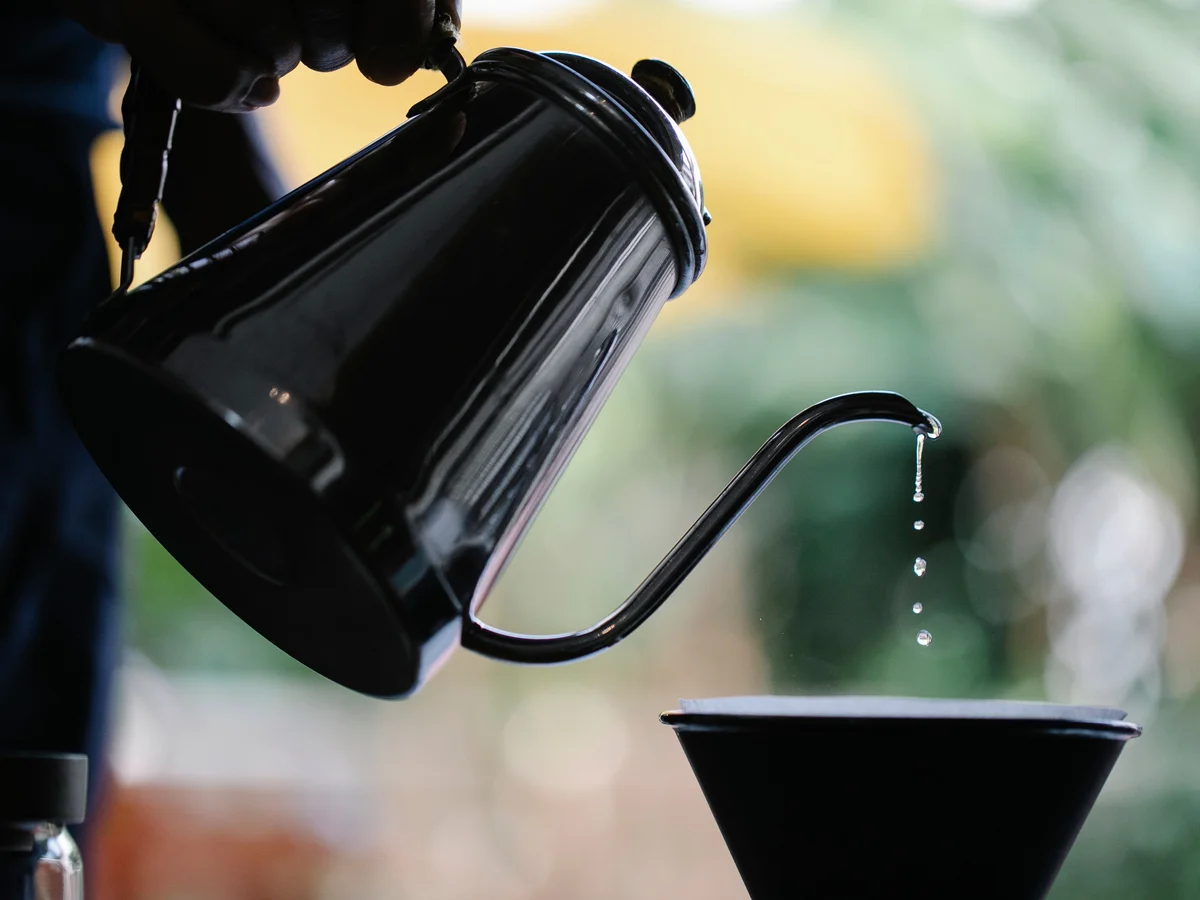
A kettle with a narrow, curved spout that gives precise control over pour rate and placement, important for even pour-over extraction.
- Type
- Kettle
- What it is for
- Water heating
- Who needs one
- Useful upgrade
- Materials
- Stainless steel, Copper
- Needs attention
- Descale according to water hardness and the manufacturer's instructions.
- Brewing methods
- 3 methods use it
Work out whether it is for you
Do you need a gooseneck kettle?
CoffeeHQ explanatory model — not a measurement
How do you brew most of your coffee?
French press, AeroPress, cold brew or a moka pot — No. The water goes in all at once, so how precisely you can pour it changes nothing. Any kettle will do.
An automatic filter machine, espresso machine or capsule machine — No. The machine delivers the water; a kettle is not part of the brew.
Pour-over, by hand
What kind of dripper?
A restricted-flow or wedge dripper with small holes — Helpful, not necessary. The dripper controls the flow for you, so a careful pour from an ordinary kettle works.
An open cone, a flat-bottomed dripper or a Chemex — Yes. With these the pour is the technique: a narrow spout is what lets you pour slowly and place the water where you want it.
Basis: Reasoned from what the spout does: it slows and narrows the stream, which only matters where the pour shapes the brew. Limits: It says nothing about temperature control, which is a separate feature some pouring kettles have and others do not.
What it is
The spout is the whole point. An ordinary kettle delivers a wide, fast, hard-to-aim stream; a gooseneck delivers a thin, slow one that lands where you put it. In pour-over the water is doing the agitating and the wetting, so how it arrives is part of the method rather than an incidental detail.
How it works
A long, narrow, curved spout slows the flow and stabilises it, and moves the point of delivery away from the body so you can see where the water is landing.
Why people use one
Because an uncontrolled pour digs channels in the coffee bed, washes grounds up the filter wall, and produces a different brew each time.
What this actually changes
Separated by what it affects, because “improves your coffee” is not something you can act on. Where the evidence is thin or contested, it says so.
Consistency
Real differenceReasoned, not measuredFor pour-over specifically. A controlled pour makes the bed behave the same way each brew, which is what makes any other adjustment readable.
Taste
DependsReasoned, not measuredSubstantial for pour-over, where pouring is part of the extraction. Negligible for immersion brewing, where the water simply needs to arrive.
Who it is for
Worth having if
- Anyone brewing V60, Kalita, Chemex or any hand pour-over regularly
Probably skip it if
- Anyone brewing French press, AeroPress, moka pot or cold brew, where an ordinary kettle is genuinely equivalent
- Anyone who makes pour-over occasionally and pours carefully from a small jug
Choosing one
What actually differs between them. No products, no rankings.
- Temperature control
- A separate feature that is often bundled. Decide whether you want the spout, the thermostat, or both.
- Spout taper
- A very narrow spout gives fine control and makes filling a large brewer slow. A moderate taper suits most people.
- Balance
- A kettle that tips forward as it empties is hard to pour steadily. Handle position matters more than weight.
- Capacity
- A full litre is heavy to pour slowly for three minutes. Match the size to the brews you actually make.
Common mistakes
Buying one for immersion brewing
Money spent on control that the method does not use.
Instead: Match the kettle to the brewing you do.
Pouring hard from height to speed things up
Digs into the bed and washes grounds up the filter wall.
Instead: Keep the stream low, slow and close to the surface.
Cleaning and care
Descale as for any kettle; the narrow spout is where scale shows first.
What you could use instead
Fine for immersion brewing and awkward for pour-over.
Same spout, no plug, no thermostat.
How to use it
Step-by-step techniques this equipment is part of.
- Blooming coffeeWet the whole coffee bed and let it release its carbon dioxide before the main pour begins.
- Pulse pouringControl agitation and contact time by pouring in several stages rather than one continuous stream.
- Rinsing a paper filterRemove papery taste, seat the filter against the brewer, and preheat the equipment in one action.
- Dialling in filter coffeeFind the grind and ratio that suit a particular coffee in a particular brewer, using brew time as a reading and never as a target.
When it goes wrong
Brewing methods that use this
Where this equipment is part of the method rather than optional.
Coffee makers that need one
Devices whose profile records this equipment as required. Each links to setup, ratio, cleaning and running cost.
Often used alongside
Other equipment this one is used with, or that the same brewing methods call for.
Drinks it appears in
Drinks that name this equipment, or that are brewed by a method requiring it.
Compare the options
Side-by-side comparisons this category appears in.
Tools that use this
Preparation traditions
Named regional traditions that use this vessel or filter, from CoffeeHQ's international preparation atlas.