Foundational
Water temperature explained
What studies found when brewing temperature was varied, why the kettle and the brewer differ, and how cold brewing changes the drink.
In short
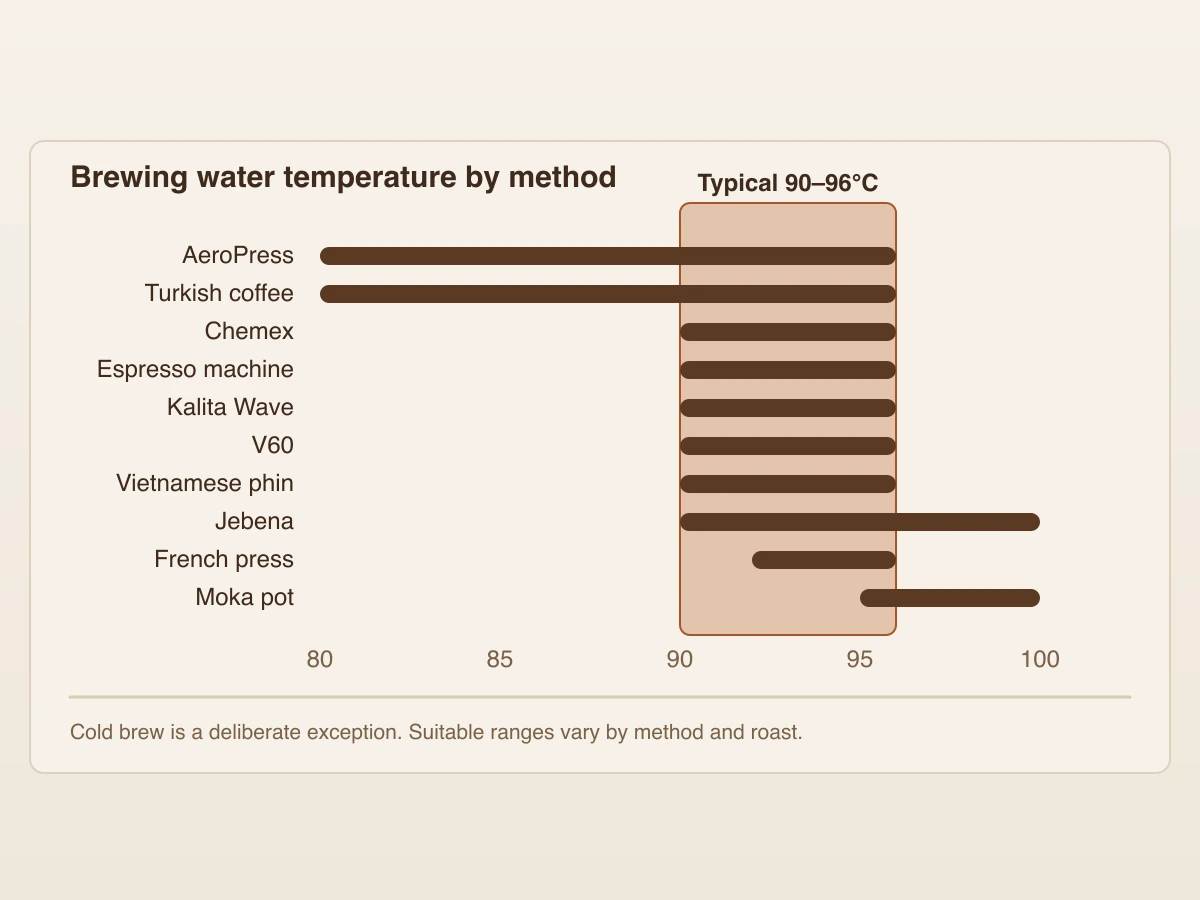
Brewing temperature is often presented as a precise requirement, with a figure close to 93 degrees Celsius described as optimal. When that figure was put to a controlled test, the result was not what the advice implies.
Temperature does matter. It changes how quickly coffee dissolves, and brewing cold produces a chemically different drink. What the evidence does not support is the idea that a degree or two either side of a particular number decides the quality of a hot brew.
What happened when temperature was tested
Sourced
Researchers at the University of California, Davis drip-brewed one coffee at 87, 90 and 93 degrees Celsius. At each temperature they adjusted the grind and the brewing time until the cup reached the same planned strength and extraction, across the range of the classic brewing chart, and gave the results to a trained panel.
Strength and extraction both changed what the panel tasted. The brewing temperature, in the authors' words, had no appreciable impact. They concluded that temperature is one of several things that affect how extraction proceeds, and that the taste is governed by where strength and extraction end up, at least over the range tested.
They also noted why the question mattered: drip brewers that do not reach 92 degrees within a set time fail an industry certification, and there was little rigorous sensory evidence for any particular range. The one attribute that moved with temperature in their own test was a nutty note, by one point on a hundred-point scale, which the authors thought might be chance.
What that result does and does not mean
CoffeeHQ explanation
It does not mean temperature is irrelevant. In the study, cooler water needed a different grind and time to reach the same strength and extraction. A home brewer who lowers the temperature and changes nothing else will extract less and taste the difference; what they are tasting is the change in extraction.
It means temperature is a way of moving extraction, alongside grind and time, with no special status. If a cup is where you want it, the kettle's exact reading is not the reason. The study covered one washed arabica from Honduras, one roast, one flat-bottomed drip brewer and a six-degree span, and should not be stretched to espresso, to much cooler water, or to every coffee.
The kettle and the brewer are not the same temperature
Widely documented
The temperature that acts on the coffee is that of the mixture of water and grounds, which is lower than the kettle's. Water cools as it is poured, the grounds and the brewer take up heat, and an open brewer loses more to the air. A cold, heavy brewer takes more than a warm, light one.
No measurement of these losses was read for this page, so no figure is given. The practical consequence is only that two people using the same kettle temperature may be brewing at different temperatures, which is one more reason not to treat a kettle setting as a recipe that transfers.
Cold water makes a different drink
Sourced
Brewing with cold water over many hours is a larger change than any adjustment to a kettle, and here chemistry does differ. A study that brewed six light-roast coffees hot and cold at the same ratio found the two had similar pH, between 4.85 and 5.13, while the hot brews had more titratable acid, meaning more acid in total, and higher antioxidant activity. The authors suggest hot water extracts acids that cold water leaves behind.
A second study from the same group, on one Colombian coffee at three roast degrees, found the cold brews less acidic by pH as well, by 0.20 to 0.34 of a unit, with less of the brown-coloured compounds and less dissolved material, and concluded that cold water extracts some compounds less effectively. Neither study included tasting, and the first's authors say more work is needed before drawing any conclusion about health; none is drawn here.
The common claim that cold brew is less acidic is therefore right about total acid and unsettled about pH. Total acid was lower in both studies. The pH was about the same in the first and somewhat higher, meaning less acidic, in the second.
Espresso
Sourced
One study varied espresso water temperature between 80 and 98 degrees Celsius alongside flow rate and grind, and measured what reached the cup in successive fractions. Flow rate had the strongest effect of the three, and higher temperature made the effect of flow rate more pronounced. Changing the temperature alone, with flow and grind at their middle settings, made no measurable difference to how the measured compounds came out. The authors describe all three influences as minor compared with how much liquid was drawn in total, and say their data support qualitative statements only. Nobody tasted the shots.
What this page does not say
CoffeeHQ explanation
It names no brewing temperature as correct, for any method or roast. Advice to use cooler water for dark roasts and hotter for light is common practice and no study testing it was read. It gives no figure for heat lost between kettle and brewer. It does not cover serving temperature or how temperature changes what is perceived in the mouth. And it makes no statement about scalding or burning coffee with boiling water, for which no evidence was found.
What to do next
- Coffee extraction — Strength and extraction are what the panel could taste; this explains both.
- Cold brew — How the method is done, with ranges and what goes wrong.
- Preheat a brewer — The practical response to heat lost into cold equipment.
- Pressure and flow in espresso — The variable that mattered more than temperature in the espresso study.