Coffee maker
Cold brew maker
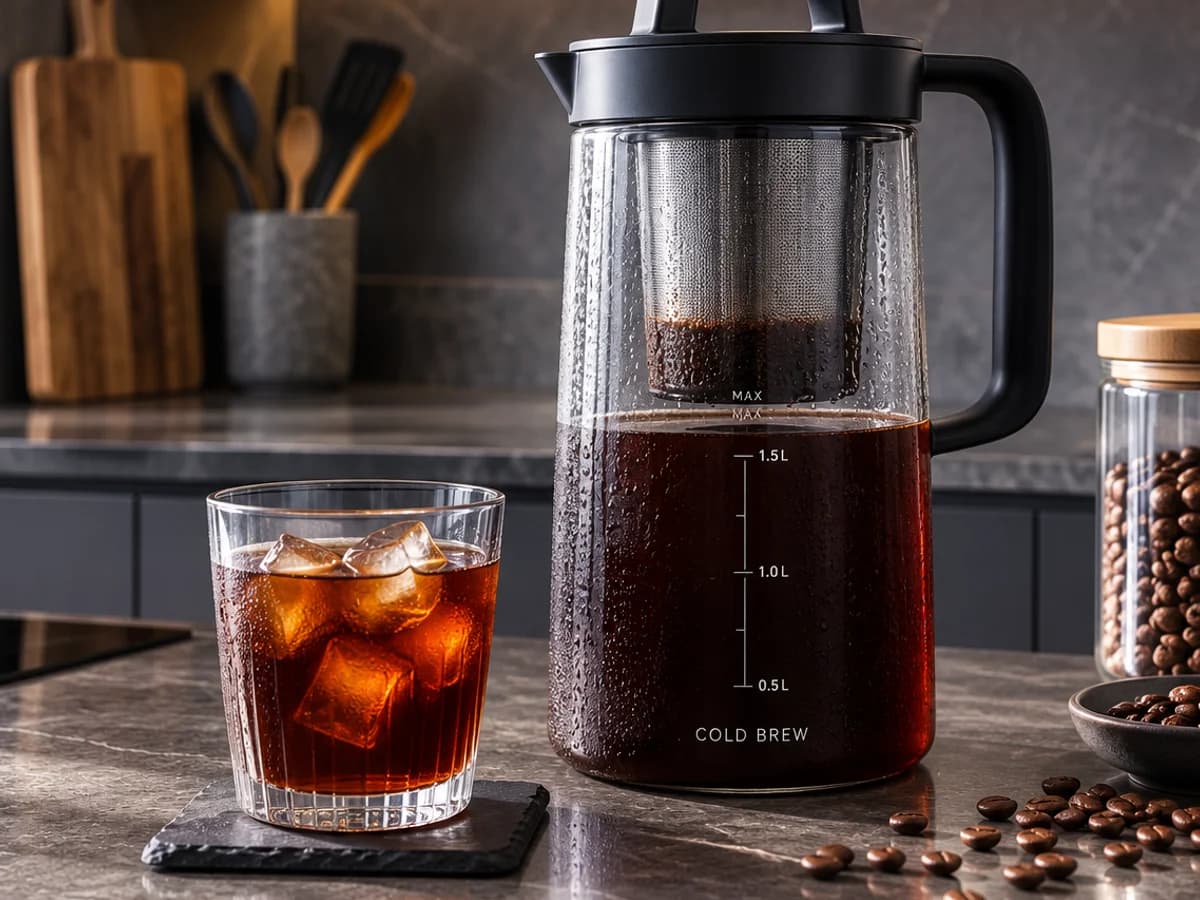
A steeping vessel with a filter used to steep coarse coffee grounds in cold water over many hours, producing a low-acidity concentrate.
In short
Cold brew needs only a container, coffee, water and time. A dedicated cold brew maker does not brew differently from a jar. What it changes is the filtering, which is the tedious part of making cold brew at home.
So the question when buying one is not which makes the best coffee. It is how you want to separate the grounds afterwards, and how much you want to make at a time.
The designs you will find
Widely documented
- Jug with a mesh core
- A pitcher with a removable mesh cylinder that holds the grounds. Lift the core out and the jug is ready to pour. Simple and compact, with some fine sediment in the result.
- Bag in a jar
- A reusable cloth or disposable paper bag of grounds steeped in any container. The cheapest route, and cloth or paper gives a cleaner drink than mesh.
- Bucket with a filter at the base
- A large vessel that drains through a thick pad or paper filter into a carafe. It makes a big batch of clear concentrate and takes up the most space.
- Slow-drip tower
- Cold water drips through a bed of coffee over hours. This is a different method, percolation rather than steeping, and a display piece as much as a brewer.
The filter decides the texture
Tendency, not a guarantee
Metal mesh lets oils and fine particles through, so the cold brew is heavier and leaves a layer of silt at the bottom of the jug. Paper and thick felt pads hold both back and give a clearer, lighter drink that also keeps a little better, because there are fewer fine grounds still sitting in it.
If a mesh maker gives a muddier result than you want, the answer is not a new maker. Pour the finished brew once through a paper filter. It is slow, but it turns a mesh-filtered batch into a clean one.
What a batch actually takes
CoffeeHQ explanation
Cold brew uses a lot of coffee per litre compared with hot brewing, particularly if you make concentrate, and the grounds soak up a good share of the water. A maker's stated capacity is the size of the vessel, not the amount of drink you get out. Expect noticeably less.
It also needs somewhere to sit for many hours. Check that the maker fits your fridge shelf or door before buying, and that you will get through a batch while it is still at its best. A small maker used often serves most households better than a large one.
Storing it safely
Widely documented
- Take the grounds out when the steep is finished. Left in, they go on extracting and the drink turns harsher.
- Keep the finished brew covered in the fridge and treat it as a perishable drink, as you would any brewed coffee or juice.
- Use it within the period the maker's instructions give. One long-established maker of a felt-filter system states that its concentrate stays fresh for up to two weeks in the refrigerator; that is one maker's statement about freshness, not a food-safety limit, and anything diluted or mixed with milk should be used much sooner.
- Wash the maker, and especially any mesh, cloth or felt filter, thoroughly between batches. Old coffee oil and trapped grounds spoil the next one.
If a batch smells sour or off, or shows any sign of mould, throw it away. Cloth and felt filters need replacing periodically, and the maker's instructions say how often: the same maker gives up to ten uses or three months for its felt filter, and has it kept damp in a sealed bag in the freezer between batches.
CoffeeHQ explanation
- Silt at the bottom of every glass
Usually because: A mesh filter is passing fine grounds, often made worse by a grind that is too fine.
Change first: Grind coarser; if that is not enough, finish through a paper filter.
- Weak coffee from a mesh-core jug
Usually because: The grounds are packed into a narrow core and the water around them barely moves.
Change first: Stir or gently shake once or twice during the steep, or use a little more coffee.
- A stale or rancid note in a fresh batch
Usually because: The filter was not cleaned properly after the last one.
Change first: Wash or replace the filter before brewing again.
What to do next
- How to make cold brew — Ratios, steep times and how to adjust strength, whatever the container.
- Cold-brew batch and dilution calculator — Works out how much coffee and water a batch needs and how to dilute it.
- Cold brew vs iced coffee — Whether you need a cold brew maker at all for a cold drink.
- Become a barista — A structured programme from dose and grind through milk, drinks and maintenance.
Owning a cold brew maker: the device, the filter and what to do with the result
The sections above describe the designs and how to store a batch. This part is about using one: what to do with a new maker, what each part does, what each change tends to do when the water is cold and the time is long, and how to tell a problem with the recipe from a problem with the filter. One maker's bottle is taken as a worked example.
Your maker's instructions come first. The lines marked as a maker's are from Hario's leaflet for its Filter-in Coffee Bottle, and one from Toddy's guide for its felt-filter system. Each is one maker's instruction for one product. Their times and keeping periods are theirs, about their own devices and about flavour; none is a food-safety limit and none is a target for other makers' devices.
I have just bought one. What do I do first?
- Work out which kind you have. A bottle or jug with a mesh strainer that holds the grounds; a jar with a bag; a vessel that drains through a pad or paper at the base; or a tower that drips. The first three steep the coffee. The tower does not, and works differently.
- Take it apart and wash everything. The vessel, the strainer or filter and every seal. Cold brew has no heat step to make up for a dirty maker.
- Check how the filter goes together. A strainer in two parts has to be locked at every point. Hario's leaflet warns that if both inserts of its strainer are not set, the coffee powder will spill out.
- Find out whether it makes a concentrate or a drink. The maker's instructions say. A bottle with a strainer usually makes something to drink as it is. A bucket with a pad usually makes a concentrate to dilute. The amounts are very different.
- Weigh the coffee and measure the water. As an example, Hario's leaflet for its bottle asks for 55 g of dark-roast, medium-fine coffee and water to about 700 ml. Use the amounts your own maker gives to begin with.
- Wet all of the coffee, close it and put it in the fridge. Pour gently, then mix gently so no dry coffee is left. Hario's instruction is to fit the stopper, shake the bottle gently, and brew it in the refrigerator.
- Take the grounds out when the time is up. Left in, they go on brewing. Lift out the strainer or drain the vessel, and keep the coffee covered in the fridge.
- Taste it, diluted if it is a concentrate, and change one thing. Judge it the way you will drink it. Then change one thing for the next batch: dilution first, since it costs nothing.
What each part of a cold brew maker is for
- The vessel
- Holds the coffee and water for hours, so its size sets the batch and it has to fit in the fridge. Glass shows you the brew and does not hold smells.
- A mesh strainer or core
- A cage that holds the grounds in the water and lifts out with them. Fine mesh lets oil and very fine particles through, so the brew is heavier and leaves silt.
- A bag
- Cloth or paper, holding the grounds in any container. It filters more finely than mesh and is lifted out and emptied, or thrown away.
- A pad or paper at the base
- In a concentrate system the brew drains through a thick felt pad or paper when a stopper is pulled. It gives a clear liquid and needs the grounds not to clog it.
- Spout, stopper and seals
- Close the vessel so it can be mixed and stored. They are silicone on many makers, and are where old coffee hides.
- A drip valve, on a tower
- Sets how fast cold water falls onto a bed of coffee. A tower percolates and does not steep, so its controls are the drip rate and the grind, not the time in the fridge.
Four kinds of maker, and what each asks of you
CoffeeHQ reasoningA jar with a bag or a filter is the simplest: coffee and water in a container, strained afterwards. You control everything and the filter you strain through decides how clear it is.
A filter-in bottle keeps the grounds in a strainer in the neck or body. It is tidy and makes a ready-to-drink brew. The strainer is small, so the coffee has to be mixed into the water at the start, and the mesh passes some silt.
A concentrate system steeps a large amount of coffee and drains it through a pad or paper. It makes a strong liquid meant to be diluted, clear and in quantity. The filter is the part that clogs and the part that needs care.
A slow-drip tower lets cold water fall through a bed of coffee over hours. It is percolation, a different method with different faults, and most of what this page says about steeping does not apply to it.
One maker's bottle as an example
Maker's instructionsHario's leaflet for its Filter-in Coffee Bottle gives its method in five steps: put 55 g of coffee in the strainer; fit the upper strainer to the lower; set the spout with the strainer on the glass bottle and pour water in gently, with the stopper out, to about 700 ml; put the stopper on and shake it gently to mix the coffee and water; put the stopper in the spout and let it brew in the refrigerator for eight hours. Before pouring, it says to shake the bottle gently.
The eight hours is Hario's instruction for this bottle with this dose. The brand's UK site describes the same bottle with a range of 8 to 24 hours. Neither is a rule for cold brew in general, and a different maker with a different filter and ratio will give a different figure.
The leaflet's other advice: use water with little chlorine smell, and soft water if it is bottled; if you warm the coffee, do not boil it; keep it in the refrigerator and finish it within two to three days; drink it as soon as possible. The reason the leaflet gives for the two to three days is that the coffee oxidises as time passes. Those are the maker's statements about flavour for its own product.
The brand's European page gives the materials as heatproof glass for the bottle, polyester for the filter, polypropylene for the strainer and silicone rubber for the spout and stopper, and the brewed volume as 650 ml.
Concentrate or ready to drink: the commonest confusion
CoffeeHQ reasoningTwo cold brews made with the same coffee can differ several times over in strength, because one recipe is written to be drunk as it is and the other to be diluted. A concentrate drunk neat is not strong cold brew; it is an undiluted ingredient.
Find out which your maker and recipe produce before judging the result. If it is a concentrate, dilute a measured amount, taste it, and write down the proportion you like. That proportion is part of the recipe.
Dilution changes strength and nothing else. It is the first thing to adjust when a batch is too strong or too weak, because it can be changed on the batch you already have.
What changes what in cold brew
Each line is a tendency and the mechanism behind it, not a promise about taste. The last part of each says what else the result depends on.
- Ratiomore coffee or more water
- Sets the strength of what comes out of the maker. A concentrate recipe uses far more coffee for the water than a ready-to-drink one.
- But it also depends on: Which kind of recipe it is, and how much water the grounds keep.
- Dilutionmore or less water or milk added afterwards
- Lowers strength and changes nothing about what was taken from the coffee.
- But it also depends on: The strength of the concentrate, and ice, which is also dilution.
- Contact timelonger or shorter
- More is taken from the coffee the longer it steeps, quickly at first and slowly later. Very long steeps are commonly found to turn woody.
- But it also depends on: The grind, the temperature and the maker. Nothing CoffeeHQ has read measures how strength climbs with hours, so no figure is given.
- Grindfiner or coarser
- Finer gives up more in the same time and puts more silt through a mesh. Coarser is cleaner and slower.
- But it also depends on: The filter. One maker's bottle asks for medium-fine; concentrate systems that drain through a pad commonly ask for coarse.
- Temperaturethe fridge, or the kitchen counter
- Warmer water extracts faster, so a room-temperature steep runs ahead of a refrigerated one.
- But it also depends on: Food safety as well as flavour. Hario's instruction for its bottle is the refrigerator.
- Agitationmixed at the start, or left
- A gentle mix at the start wets all of the coffee, which matters most where the grounds sit in a small strainer. Stirring later lifts fine particles.
- But it also depends on: The maker. Hario asks for a gentle shake at the start and again before pouring.
- The filtermesh, cloth, paper or felt
- Mesh passes oil and fine particles: heavier and silty. Paper, cloth and felt hold both back: clearer and lighter.
- But it also depends on: The grind, and how clean the filter is.
- The coffeedarker or lighter, fresher or older
- A darker roast gives the chocolate and low acidity cold brew is known for. A light roast can taste thin or sharp brewed cold.
- But it also depends on: Taste. One maker's leaflet specifies a dark roast for its bottle.
When cold brew goes wrong
For each thing you might notice: what to consider, since there is rarely one cause, and the first thing to try. One change, then brew again.
- It is weak
Consider
- Too much water or milk added afterwards
- Melting ice
- Too little coffee for the water
- Dry coffee left in the strainer that never met the water
- A short steep with a coarse grind
Try first: Taste it undiluted. If that is strong enough, dilute less. If the undiluted brew is thin, check all the coffee was wetted, then use more coffee next time.
- It is very concentrated
Consider
- It is a concentrate and is meant to be diluted
- A lot of coffee for the water
- A long steep
Try first: Dilute a measured amount a little at a time until it is where you like it, and note the proportion.
- You are not sure how much to dilute it
Consider
- Whether the recipe makes a concentrate or a drink
- Whether ice and milk are being counted as dilution
- That the water the grounds keep is not in the jug
Try first: Start from what the maker's instructions say the result is, dilute by weight, taste, and adjust. The dilution tool does the arithmetic.
- It is muddy
Consider
- A mesh filter, which passes fine particles by design
- A grind finer than the filter can hold
- It was shaken or stirred just before pouring
Try first: Let it stand and pour gently, leaving the last of it. For a clear result, strain a second time through rinsed paper or cloth.
- There is a lot of sediment at the bottom
Consider
- A grind with a lot of very fine particles
- A strainer that is not locked together
- A torn bag or a worn mesh
Try first: Check the strainer is assembled at every point, as its maker shows. Then grind a step coarser.
- It is flat or dull
Consider
- The coffee was past its best
- The batch has been kept a while
- Old oil in the filter, the seals or the vessel
- The water
Try first: Smell the empty, washed maker and its filter. If they smell of old coffee, clean or replace them. Then make a small batch with fresher coffee.
- It will not drain, or filters very slowly
Consider
- A fine grind packed against the pad or paper
- The grounds were stirred after they had settled
- A pad that is clogged with old oil
- More coffee than the system is built for
Try first: Do not stir it to hurry it. Next time grind coarser and leave the bed alone once it is wet. Wash or replace the pad as its maker directs.
- The filter is clogged and will not come clean
Consider
- Coffee oil dried into a mesh or pad
- A felt or cloth filter past its useful life
- A filter stored damp in the open
Try first: Soak and brush a mesh. A cloth or felt filter has a life, and its maker says what it is: Toddy gives up to ten uses or three months for its felt filter.
Change one thing, observe, learn
Each of these changes one thing and holds the rest. Brew the two side by side where you can, and write down what you notice before deciding which you prefer.
One concentrate at three dilutions
- Change
- Dilute three measured glasses from one batch: a little, the maker's suggestion, and more.
- Keep the same
- It is one batch.
- What to notice
- Where it stops being strong and starts being thin. That proportion is your recipe.
Two steep times
- Change
- Make two small batches and take the grounds out of one several hours before the other.
- Keep the same
- The coffee, the grind, the ratio and the fridge.
- What to notice
- How much the longer one gains, and whether anything unpleasant arrives with it.
Mesh against paper
- Change
- Pour half a finished batch through a rinsed paper filter and leave the other half as it is.
- Keep the same
- It is one batch.
- What to notice
- Clarity, weight in the mouth and what is left at the bottom of each glass.
Mixed at the start against left alone
- Change
- In a filter-in bottle, shake one batch gently at the start and leave another unshaken.
- Keep the same
- The coffee, the amounts and the time.
- What to notice
- The strength of each. It shows how much depends on all the coffee meeting the water.
What to avoid
- Leaving a finished batch at room temperature. Hario's instruction for its bottle is to always store it in the refrigerator.Maker's instructions: HARIO Co., Ltd.
- Boiling it, if you warm it. Hario's leaflet says to avoid boiling, because the flavour will be lost.Maker's instructions: HARIO Co., Ltd.
- Assembling a two-part strainer at only one point. Hario warns that the coffee powder may spill out if both inserts are not set.Maker's instructions: HARIO Co., Ltd.
- Carrying Hario's bottle by its silicone spout or stopper. The leaflet says the glass may fall out, that hot liquid softens the silicone so it fits loosely, and that a bottle of hot liquid should be left to cool before it is carried.Maker's instructions: HARIO Co., Ltd.
- Putting the bottle in the freezer with liquid in it, knocking or scraping the inside of the glass with a metal spoon, or using glass that is cracked, chipped or badly scratched, which the leaflet says may break unexpectedly. It also asks that the bottle be kept out of the reach of young children.Maker's instructions: HARIO Co., Ltd.
- Treating a maker's keeping time as a safety limit, or as longer than it is. Cold brew has had no heat step. Keep it cold and covered, use it within the period its maker gives, and throw away any batch that smells or tastes off or shows mould.CoffeeHQ reasoning
- Keeping a batch once milk has been added. Treat that as you would any milk drink.CoffeeHQ reasoning
- Taking one maker's time as a target for another's device. Eight hours is one maker's figure for one bottle.CoffeeHQ reasoning
- Drinking a concentrate undiluted and judging the recipe by it.CoffeeHQ reasoning
- Changing the ratio, the time and the grind in one batch. A batch takes a day, so a muddled result costs a day.CoffeeHQ reasoning
Cleaning, and the parts that wear
Every time
- Empty the grounds and wash the vessel, the strainer and every seal after each batch. Take seals and stoppers off to wash under them.Common practice
- Let everything dry before putting it together again. A damp, closed maker is where smells start.Common practice
From time to time
- Soak a mesh strainer and brush it gently when it looks dull or feels slick, since coffee oil closes the mesh. Fine mesh is easily damaged by pressure.Common practice
- Hario's leaflet has its bottle washed with a soft sponge and mild washing-up liquid, without abrasive sponges, scouring pads or abrasive cleansers, and says not to press hard on the mesh of the strainer from outside. It allows a dishwasher, and diluted household bleach for stubborn stains, but not a long soak of the plastic strainer in bleach.Maker's instructions: HARIO Co., Ltd.
- Look after a felt or cloth filter as its maker says. Toddy has its felt filter rinsed without soap and kept damp in a sealed bag in the freezer between batches.Maker's instructions: Toddy, LLC
Parts that wear
- Felt and cloth filters
- Slow draining and a stale smell that washing does not remove. Toddy gives up to ten uses or three months for its felt filter; other makers give their own.Maker's instructions
- Mesh strainers
- A tear, or a seam that has opened, and grounds in the brew that were not there before.CoffeeHQ reasoning
- Silicone seals, spouts and stoppers
- A seal that no longer closes, or that holds a smell after washing. They are usually sold as spares.CoffeeHQ reasoning
- The glass
- A chip, a crack or heavy scratching. Hario's leaflet says not to use such glass, since it may break unexpectedly.Maker's instructions
What else changes how it is used
Only the things that change the brewing. None of this is a list of things to buy.
- A scale
- Ratio and dilution are both done by weight, and both are where cold brew goes wrong.
- Paper filters or a cloth
- For straining a mesh-filtered batch a second time when you want it clear.
- A covered container for the fridge
- For the finished brew once the grounds are out, if the maker is not also the store.
- Spare filters and seals of the maker's own
- The parts that wear, and the usual cure for a maker that has gone stale.
From the first brew to knowing it well
- Make one clean batch by the maker's instructions. Their coffee, their amounts, their time. It gives you something to compare with.
- Settle the dilution. By taste and by weight, written down. This fixes most complaints about strength.
- Then the ratio. If no dilution suits, change the amount of coffee in the next batch.
- Then the time, then the grind. One at a time. A batch takes a day, so each experiment has to answer one question.
- Choose the texture. Mesh for weight, paper or cloth for clarity. It is the filter, not the recipe.
Improve this, from here
- Cold brew dilution calculator — Turns a concentrate and a target strength into what to add.
- Make my coffee better: cold brew — Tick what you noticed and get the possibilities, the quickest check and one change.
- Coffee-to-water ratio calculator — Coffee for the batch your maker holds.
- Caffeine estimator — A concentrate carries a great deal more per glass than it seems until it is diluted.
- Grind size guide — Where a cold brew grind sits, and what to check when the grinder is behind the silt.
- Water suitability helper — For a batch that is flat whatever you change.
- Cold brew, the method — Why cold extraction tastes different, a batch recipe and how to keep it.
- Cold brew or iced coffee? — Two cold drinks made in opposite ways.
- Ready-to-drink coffee and concentrates — What a concentrate is, how the bought kind is made and kept, and why dilution is the recipe.
How it works
Coarse grounds steep in cold or room-temperature water for many hours (recipes commonly give 12 to 24), then a built-in or separate filter removes the grounds, leaving a concentrate typically diluted before drinking.
Who it suits
- users who prefer low-acidity, smooth iced coffee
- users happy to plan a day ahead for their brew
Who it may not suit
- users wanting coffee quickly
- users wanting hot coffee
- Starting dose
- 100g
- Starting water
- 1000ml
- Coffee-to-water ratio
- 100–150 g per litre (typically 125)
- Grind
- Coarse.
- Capacity
- 4-12 cups
- Brew time
- 720-1440 min
- Skill level
- beginner
- Noise
- quiet
- Space
- medium
- Cleaning burden
- low
- Convenience
- low
- Manual control
- medium
Descriptive grind labels like this are illustrative starting points, not precise measurements — the same label can mean different particle sizes on different grinders. See the grind size guide for how to dial this in on your own equipment.
Uses the Cold brew steeping brewing method.
Equipment
Requires a separate grinder.
Advantages
- smooth, low-acidity result
- a batch can be made ahead and kept refrigerated; how long is a food-safety question the ready-to-drink guide covers
- no electricity needed
Disadvantages
- requires many hours of lead time
- takes up refrigerator space during steeping
Steps
- Combine coarse coffee grounds with cold or room-temperature water in the steeping vessel.
- Steep for the time your recipe gives; 12 to 24 hours is the commonly quoted range, and steeping in the refrigerator is the cautious choice.
- Filter thoroughly, then dilute the concentrate to taste before serving.
Cleaning & maintenance
Discard grounds and rinse the steeping vessel and filter thoroughly after each batch.
Replace reusable mesh filters if they become clogged or torn.
Consumables: paper or mesh filters (system-dependent)
Common faults
- concentrate too weak or too strong for the intended dilution
- cloudy or gritty concentrate
Cost
Purchase cost band: budgetWidely available at a low price point; DIY jar-and-filter setups are also common.
No filters strictly needed for mesh systems — ongoing cost is mainly beans, used at a higher dose than hot methods.
Suitable roast levels
Not sure if this is right for you? Try the coffee-maker selector.